 Playable Books
Concept index · Chords
Augmented sixth chords
Taught in 5 books. Each one opens at the passage; ▶ plays the example beside it. Also called augmented sixth, german sixth, french sixth, italian sixth.
This index is Playable Books’ own: a first pass that finds the term’s words in each book, corrected by hand. The authors did not tag these passages, and their terms can differ (Fux’s “ligature” is a suspension). The quoted text is the book’s.
 Practical Manual of HarmonyNikolai Rimsky-Korsakov, 1910
Start: The augmented sixth chord →- Enharmony of Augmented-Sixth Chords · 7 playable examples
- The Dominant Seventh Chord with Augmented Fifth
3) Its effect will only be better if it is used in a position that gives the inversion of the diminished third, that is, the augmented sixth.
▶ Fig. 350 nearby - The augmented sixth chord
§ 82. — 1) To give a clear idea of the augmented sixth chords, we shall form them on the VIth degree of the harmonic major and minor modes, so that these altered chords, which derive from the IInd and the IVth degree of these two modes, will always have the…
▶ Fig. 352 nearby - The augmented sixth chord
a) Augmented sixth chord; enharmonic with the incomplete dominant seventh chord; it can occur in major and in minor.
▶ Fig. 354 nearby - The augmented sixth chord
2) All the chords set out above, which, through the enharmonic equivalence of their augmented sixth, give the same sound as the dominant seventh chord, serve as a means of enharmonic modulation.
▶ Fig. 355 nearby - The augmented sixth chord
4) The notes forming the augmented sixth must never be doubled.
▶ Fig. 355 nearby - The augmented sixth chord
6) The augmented sixth has the following influence on the plagal cadences of the major mode, which we discussed in § 40:
▶ Fig. 356 nearby
7 more passages in Practical Manual of Harmony →
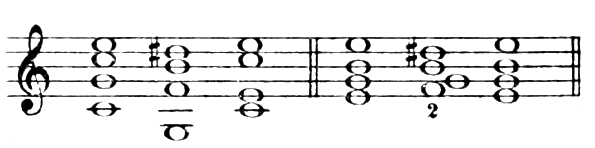 ▶ [Example]
The Dominant Seventh Chord with Augmented Fifth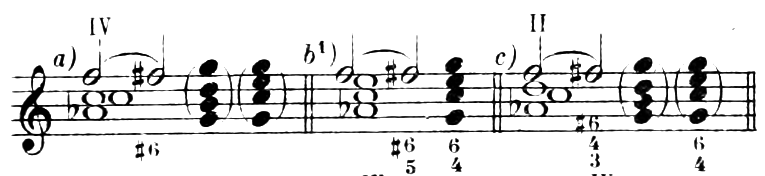 ▶ Example (major, on A♭, the VIth degree of C harmonic major): a) chord derived from IV, A♭–C–C with F rising to F♯ (augmented sixth A♭–F♯), resolving either to the G major chord or to the C major 6/4 chord over G (both in parentheses); b¹) A♭–C–E with F rising to F♯ (♯6 5), resolving to the C major 6/4 chord; c) chord derived from II, A♭–C–D with F rising to F♯ (♯6 4 3), resolving either to the G major chord or to the C major 6/4 chord (both in parentheses).
The augmented sixth chord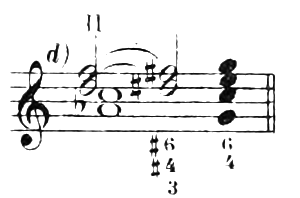 ▶ Example (major): d) chord derived from II, A♭–C with D rising to D♯ and F rising to F♯ (♯6 ♯4 3), resolving to the C major 6/4 chord over G (6 4).
The augmented sixth chord ▶ Example in minor (C minor, three flats; A♭ is the VIth degree): a) chord derived from IV, A♭–C–C with F rising to F♯ (♯6), resolving either to the G major chord (with B♮) or to the C minor 6/4 chord (both in parentheses); b²) chord derived from IV, A♭–C–E♭ with F rising to F♯ (♯6 5), resolving to the C minor 6/4 chord; c) chord derived from II, A♭–C–D with F rising to F♯ (♯6 4 3), resolving either to the G major chord or to the C minor 6/4 chord (both in parentheses).
The augmented sixth chord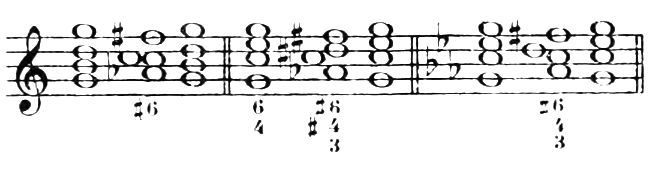 ▶ Example: each augmented sixth chord is preceded and followed by its own chord of resolution. (1) C major: G major chord; A♭–C–C–F♯ (♯6); G major chord. (2) C major: C major 6/4 chord over G (6 4); A♭–C–D♯–F♯ (♯6 ♯4 3); C major 6/4 chord. (3) C minor (key signature of three flats): C minor 6/4 chord over G; A♭–C–D–F♯ (♯6 4 3); C minor 6/4 chord.
The augmented sixth chord ▶ Example: four plagal cadences in C major, each ending on the C major chord with C in the bass, the top part D rising to D♯ (the augmented sixth above the bass F) before resolving to E. (1) II: F–A–C with D–D♯ (6 5 3); (2) II harm.: F–A♭–C with D–D♯ (6—♯ 5 ♭3); (3) VII: F–A–B with D–D♯ (6—♯ 4 3); (4) VII harm.: F–A–B with D–D♯ (6—♯ 4 ♭3).
The augmented sixth chord
 Guide to the Practical Study of HarmonyPyotr Ilyich Tchaikovsky, 1900
Start: Chapter XXVII. Chords of the augmented Sixth →- Table of contents
Chapter XXVII. Chords of the augmented Sixth — 106
- Chapter XVIII. Direct Modulation
Instead of an augmented sixth use rather a diminished third.
▶ Fig. 182 nearby - Chapter XXVI. Chords of the augmented Fifth
Ili, The chord of the seventh with the augmented fifth and major seventh. IV. The chords of the augmented sixth.
▶ Fig. 276 nearby - Chapter XXVI. Chords of the augmented Fifth
…augmented fifth lies above the seventh and forms with the latter interval an augmented sixth. The inverse relation of these two tones, the diminished third, is to be avoided. For which reason the second inversion of the Dominant-Seventh chord with altered…
▶ Fig. 289 nearby - Chapter XXVII. Chords of the augmented Sixth
…case demands. This would, however, be decidedly fallacious. A chord of the augmented sixth on the 6-th degree is nothing else than a modulatory degression into the key of the Dominant; this degression is indeed so unnoticeable, that without the help of a…
▶ Fig. 304 nearby - Chapter XXVII. Chords of the augmented Sixth
§ 104. There is still a fourth chord of the augmented sixth, which is frequently applied in cadences of the first class. This chord is found not on the 2-nd degree, but on the chromatically lowered 6-th degree; itis an augmented chord of the fourth and third…
▶ Fig. 304 nearby
2 more passages in Guide to the Practical Study of Harmony →
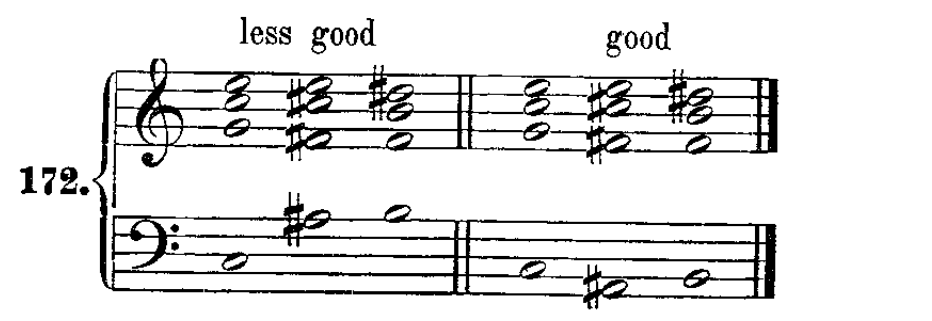 ▶ Fig. 182
Chapter XVIII. Direct Modulation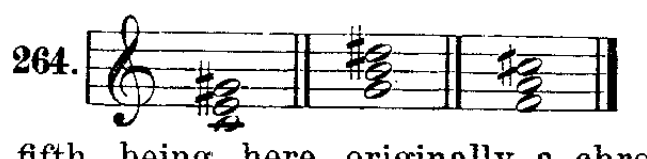 ▶ Fig. 276
Chapter XXVI. Chords of the augmented Fifth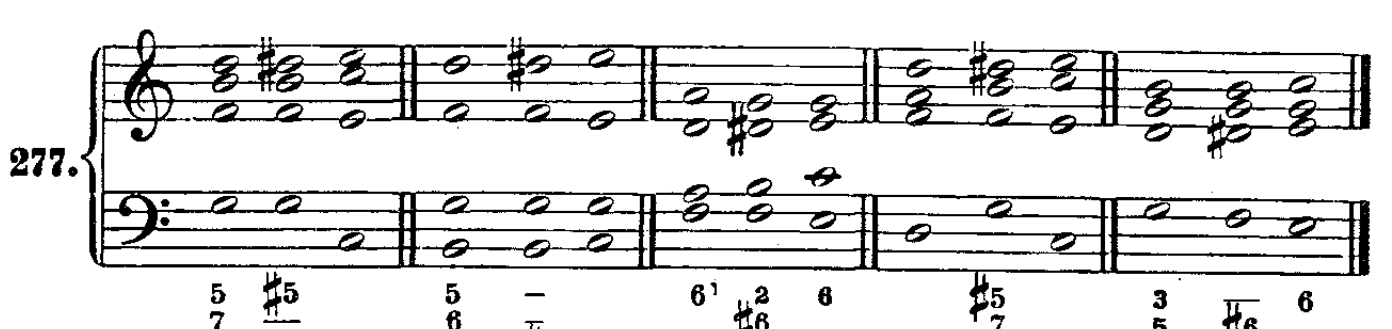 ▶ Fig. 289
Chapter XXVI. Chords of the augmented Fifth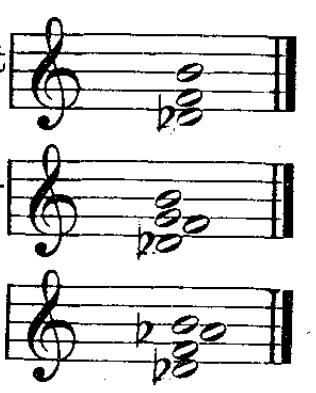 ▶ Fig. 296
Chapter XXVII. Chords of the augmented Sixth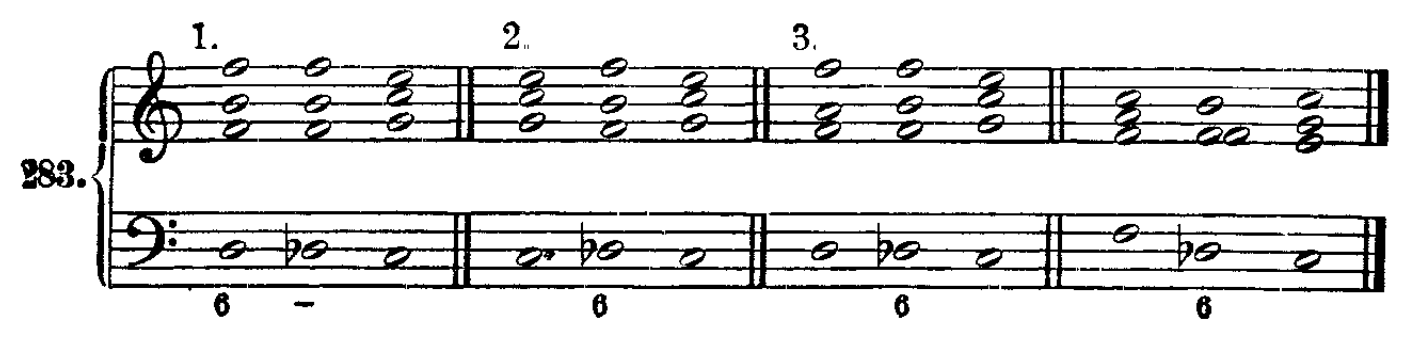 ▶ Fig. 297
Chapter XXVII. Chords of the augmented Sixth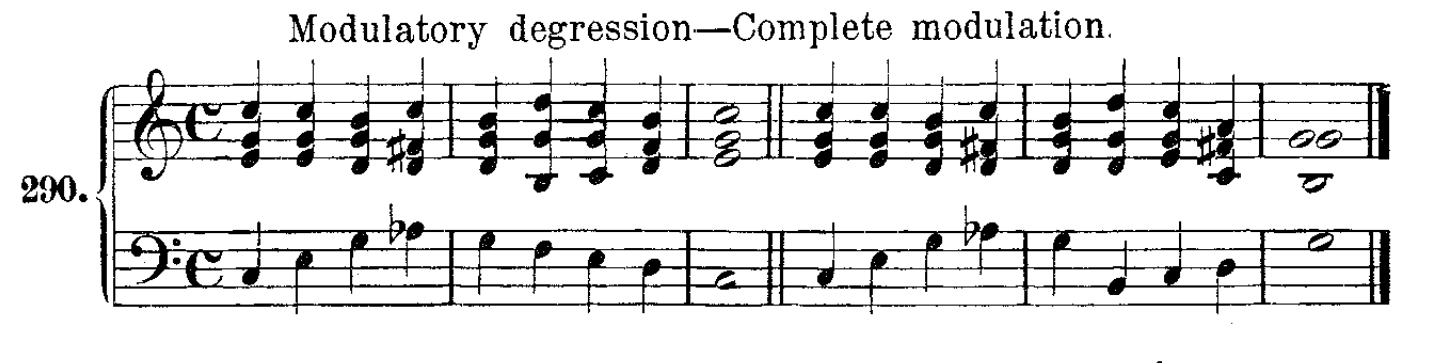 ▶ Fig. 304
Chapter XXVII. Chords of the augmented Sixth
 PartimentiFedele Fenaroli, 1800
- Musical Axioms
Give an augmented sixth to a ♭⑥ that descends to the ⑤. This augmented sixth should rise to the octave of the ⑤.
▶ Fig. 42 nearby
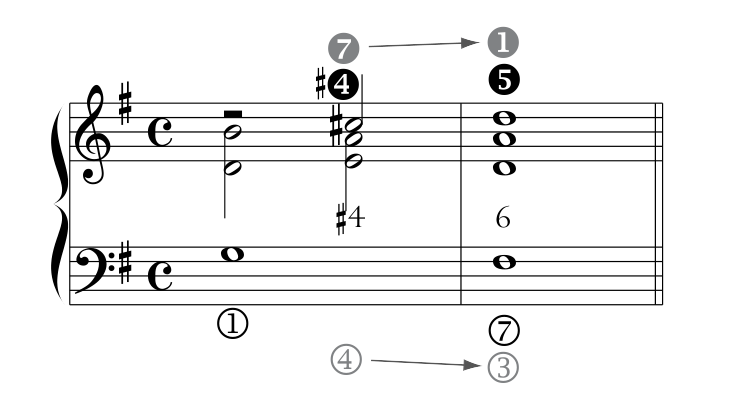 ▶ Fig. 42
 Theory of HarmonyArnold Schoenberg, 1922
Start: Augmented Sixth and Vagrant Chords →- At the Boundaries of the Key
…further: the augmented six-five, four-three, and second chords, and the augmented sixth chord, derived from degree II and on other degrees. Some other alterations of degree II, and the same alterations on other degrees. Connections between altered and vagrant…
▶ Fig. 286 nearby - Augmented Sixth and Vagrant Chords
The so-called augmented sixth chord needs no further explanation. It is nothing other than an augmented six-five chord without the ninth—or, under the other derivation, the seventh (184b)—and thus stands in a relation to that chord similar to that of the…
▶ Fig. 306 nearby - Augmented Sixth and Vagrant Chords
…work out the other inversions, four-three and second chords, as well as the augmented sixth chord, independently.
▶ Fig. 316 nearby - Subject index
Augmented sixth chord 300 f.
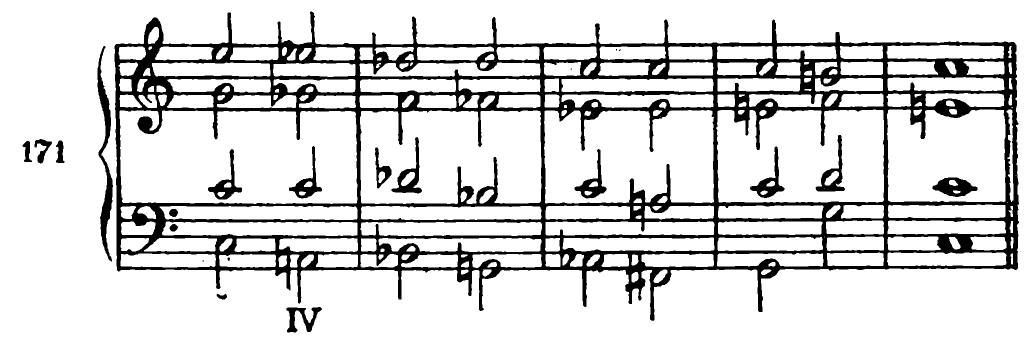 ▶ Example 171
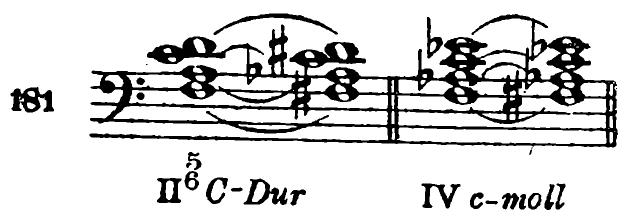 ▶ Example 181a
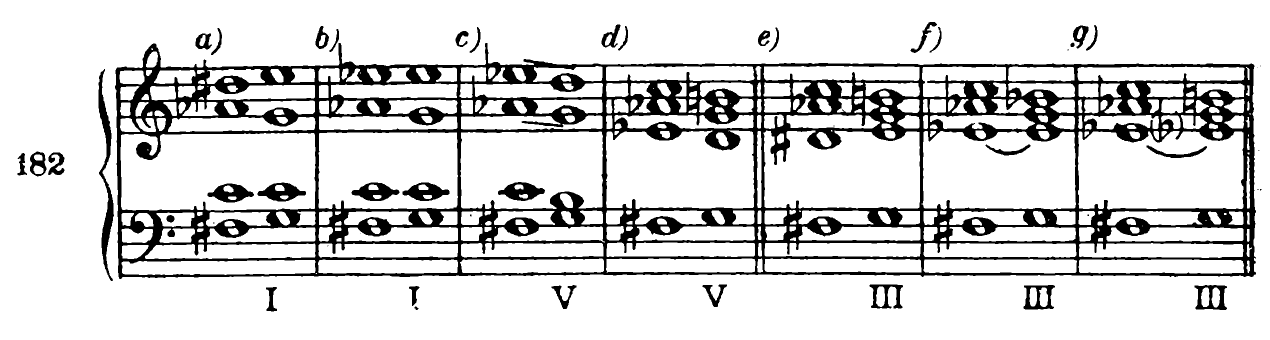 ▶ Example 182a
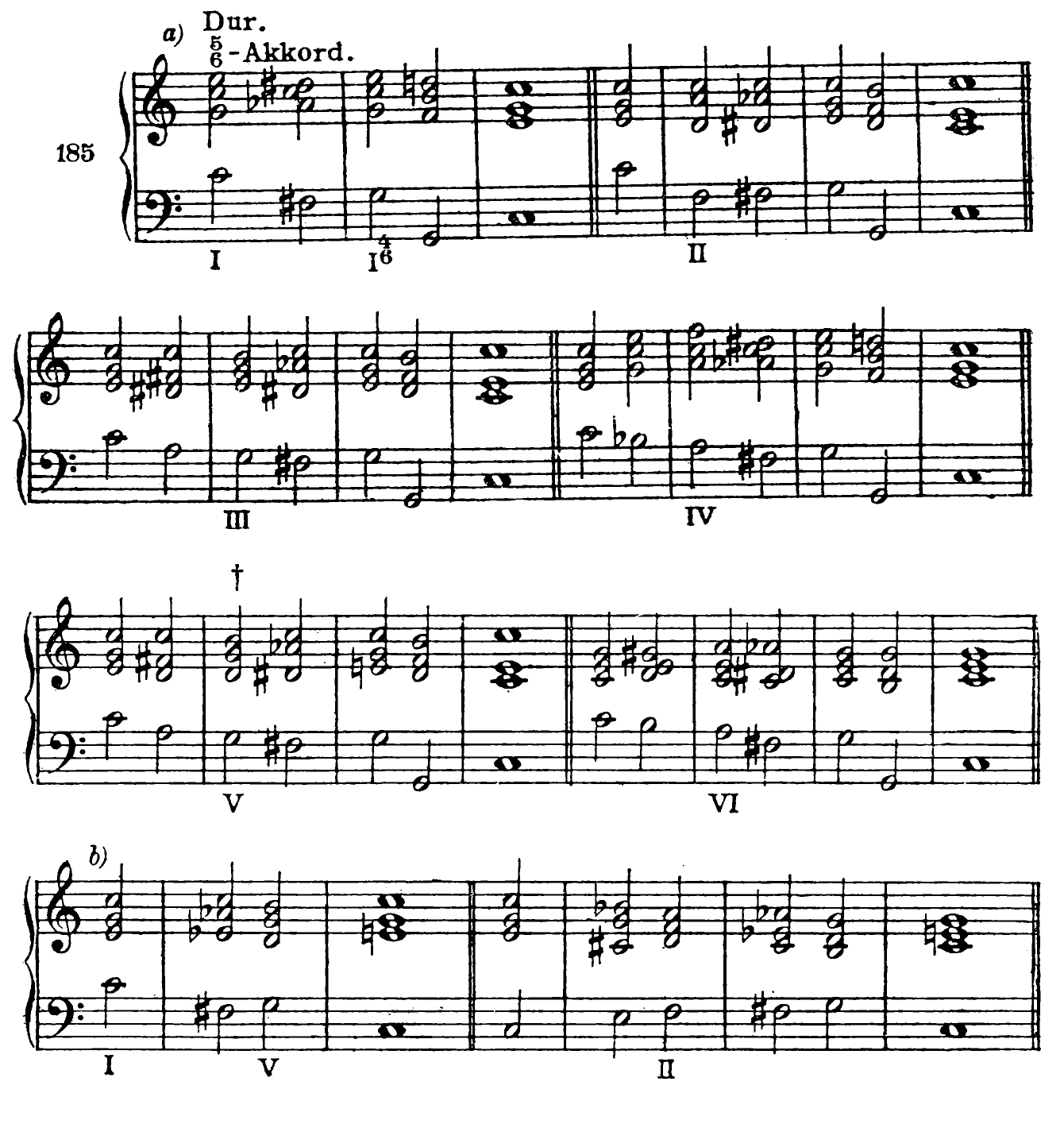 ▶ Example 185a-I (PDF314; example continues on PDF315)
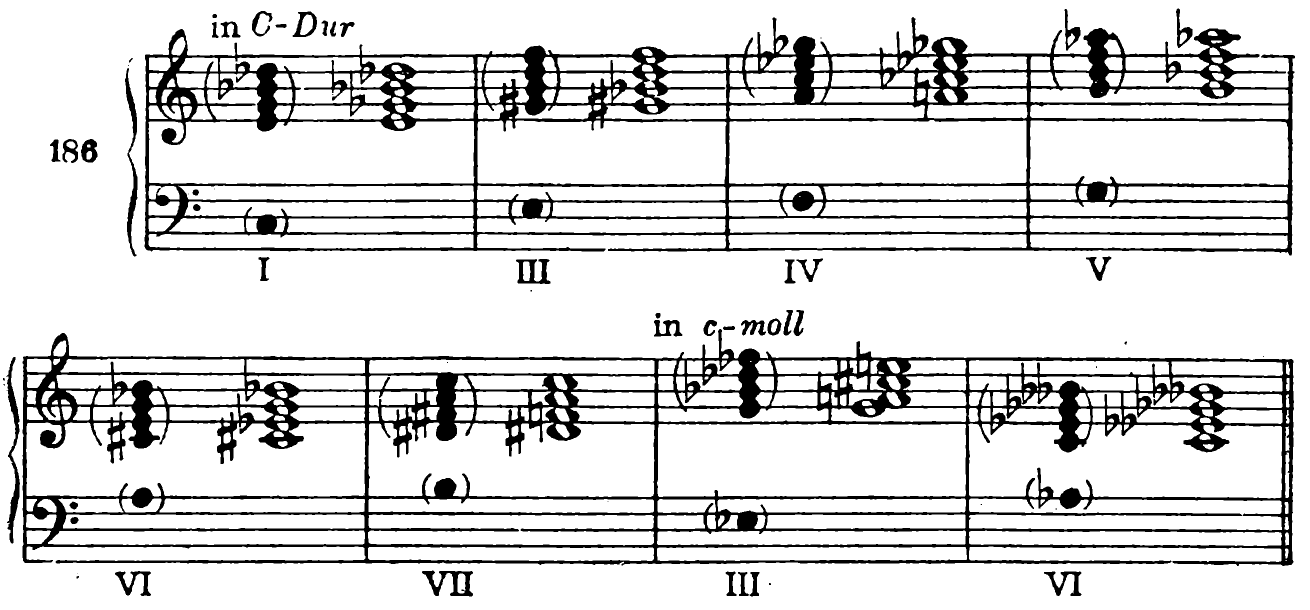 ▶ Example 186 major-I
 OrchestrationCecil Forsyth, 1914
- No. 52. The Harp
It need scarcely be said that all these chords are used "enharmonically " in the ordinary sense of the word. The dominant sevenths are used as augmented sixths: the sharp and flat nomenclatures are used at discretion to represent each other in sound.
More in Chords
Triads · Inversions and the chord of the sixth · The six-four chord · Seventh chords · The diminished seventh chord · Ninth chords · The Neapolitan sixth · Secondary dominants · Borrowed chords (mixture)