 Playable Books
Concept index · Chords
The Neapolitan sixth
Taught in 5 books. Each one opens at the passage; ▶ plays the example beside it. Also called neapolitan, neapolitan chord, neapolitan sixth chord.
This index is Playable Books’ own: a first pass that finds the term’s words in each book, corrected by hand. The authors did not tag these passages, and their terms can differ (Fux’s “ligature” is a suspension). The quoted text is the book’s.
 Practical Manual of HarmonyNikolai Rimsky-Korsakov, 1910
Start: CHORDS PRODUCED BY THE LOWERING ALTERATION OF THE IInd DEGREE →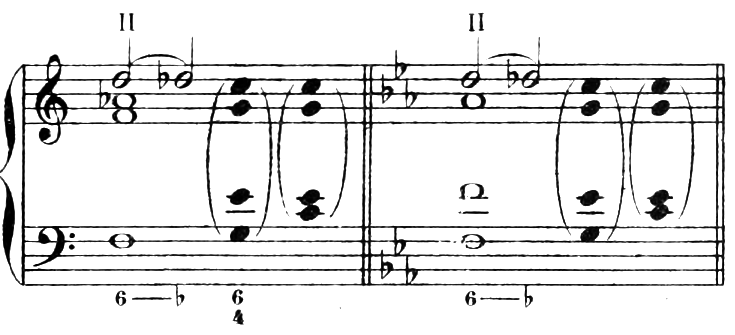 ▶ Example in C major and then C minor: the II chord over F (6) with the soprano D moving to Db (6–b), i.e. the lowered second degree Db–F–Ab with doubled F; it resolves either to the cadential six-four (6/4) or to the tonic triad, both shown as alternatives in parentheses.
CHORDS PRODUCED BY THE LOWERING ALTERATION OF THE IInd DEGREE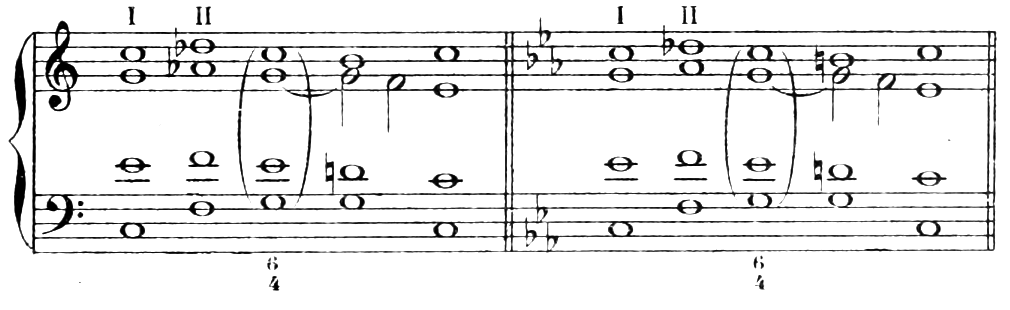 ▶ Example in C major and then C minor: I – II (the lowered second degree Db–F–Ab over F, as an independent chord) – in parentheses the cadential six-four (6/4), whose alto G is held into the dominant seventh and falls G–F – I.
CHORDS PRODUCED BY THE LOWERING ALTERATION OF THE IInd DEGREE
 PartimentiFedele Fenaroli, 1800
- Book III: Rules and realizations
Because the concept of the scale degree or scale step is so central to the Neapolitan school of partimenti, and because the welter of numbers for both intervals and scale degrees can be confusing, scale degrees in the bass will be marked by numbers in white…
 Supplement to the Theory of ModulationMax Reger, 1904
- From C-major · Footnote
By “Chord of the Neapolitan sixth”, I mean the minor sub-dominant of a major or minor key, with unprepared suspension of the minor sixth before the fifth, which suspension need not necessarily be resolved upon the fifth of the minor sub-dominant. I call this…
▶ Fig. 13 nearby - From C-major
Tonic C-major; take the 1st inversion (chord of the sixth) of this; use this chord of the sixth (e g c), which is also the chord of the Neapolitan sixth in B-major; dominant (F♯-major) of B-major; take this F♯-major in its 1st inversion, (chord of the sixth a♯…
▶ Fig. 61 nearby - From C-major
Tonic C-major; dominant (G-major) of C-major; this G-major arranged as chord of the sixth (b d g) is used, which is at the same time the chord of the Neapolitan sixth in F♯-major; dominant (C♯-major) of F♯-major, which C♯-major is, arranged in the 1st…
▶ Fig. 63 nearby - From C♭-major
Tonic C♭-major; dominant (G♭-major) of C♭-major; use the 1st inversion of this G♭-major (chord of the sixth b♭ d♭ g♭), which is at the same time chord of the Neapolitan sixth in F-major; dominant (C-major) of F-major; use the 1st inversion of this C-major,…
▶ Fig. 174 nearby - From C♭-major
Tonic C♭-major; dominant (G♭-major) of C♭-major; use the 1st inversion of this G♭-major (chord of the sixth b♭ d♭ g♭), as it is at the same time chord of the Neapolitan sixth in F-major; dominant (C-major) of F-major; use the 1st inversion of this C-major…
▶ Fig. 176 nearby - From a♯-minor
Tonic a♯-minor; chord of the Neapolitan sixth (d♯ f♯ b) in a♯-minor; use this chord of the sixth (d♯ f♯ b), which is at the same time the 1st inversion of the dominant (B-major) of E-major; tonic E-major; use this E-major, which is also dominant in a-minor;…
▶ Fig. 205 nearby
59 more passages in Supplement to the Theory of Modulation →
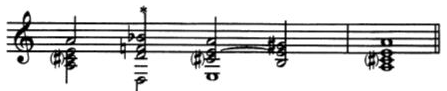 ▶ Extra-p31
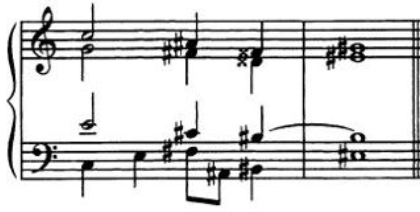 ▶ Ex-30
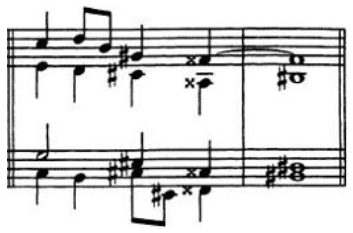 ▶ Ex-31
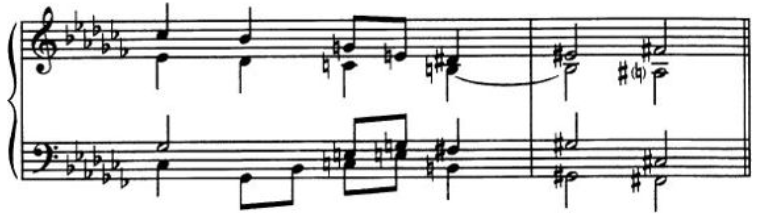 ▶ Ex-86
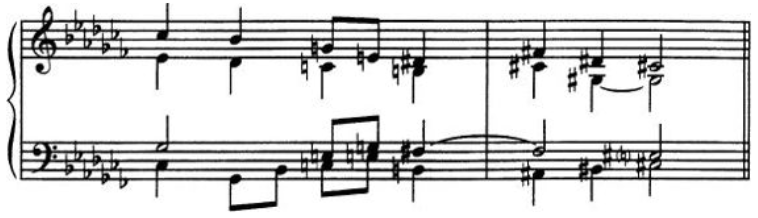 ▶ Ex-87
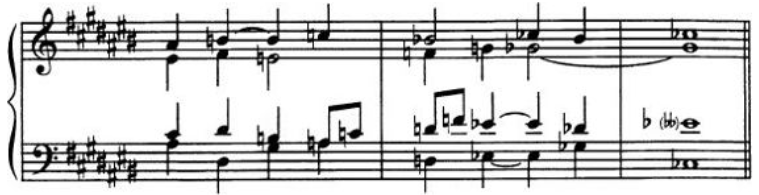 ▶ Ex-100
 Theory of HarmonyArnold Schoenberg, 1922
Start: Guidelines →- Guidelines
The Neapolitan sixth is therefore best regarded as a substitute for degree II in the cadence. In this sense it is sometimes also used as a six-four chord (168a); moreover, the chord made up of its tones is also used in root position, through the effect of the…
▶ Fig. 282 nearby - Guidelines
Any first-inversion major triad can imitate the function of the Neapolitan sixth, including those on degrees I and V. These two, however, do not lead to diatonic chords (169g and h), and are therefore unusable for the time being. But if we proceed in the…
▶ Fig. 283 nearby - Augmented Sixth and Vagrant Chords
…the dominant of the dominant in A minor, the secondary dominant on II; the Neapolitan sixth in A minor is V in E-flat minor; and the Neapolitan sixth of E-flat minor likewise coincides with V of A minor. To someone who has recognized how rich the relationships…
▶ Fig. 338 nearby - Augmented Sixth and Vagrant Chords
…the connection of augmented six-five, four-three, and second chords with the Neapolitan sixth rests on their sounding identical to the seventh chord and its inversions that could be understood as the dominant of the Neapolitan sixth. In such cases the six-five…
▶ Fig. 354 nearby - Modulation through Intermediate Keys
…what this II is: a rearrangement, into root position, of the tones of the Neapolitan sixth chord. If, here and in similar cases, we temporarily understand the Neapolitan sixth as a tonic and call it I merely to make the root progressions easier to follow, the…
▶ Fig. 375 nearby - Fifth and Sixth Circles of Fifths
…recently. In 211c, for example, the modulation C–G is introduced through the Neapolitan sixth; in 211f, the Neapolitan sixth of F minor is itself introduced through the corresponding augmented four-three chord. These means allow the “lingering on the dominant”…
▶ Fig. 397 nearby
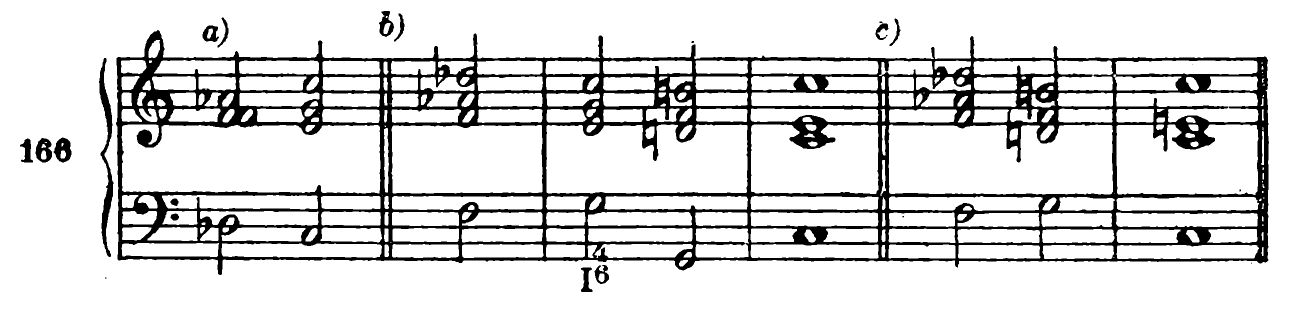 ▶ Example 166a
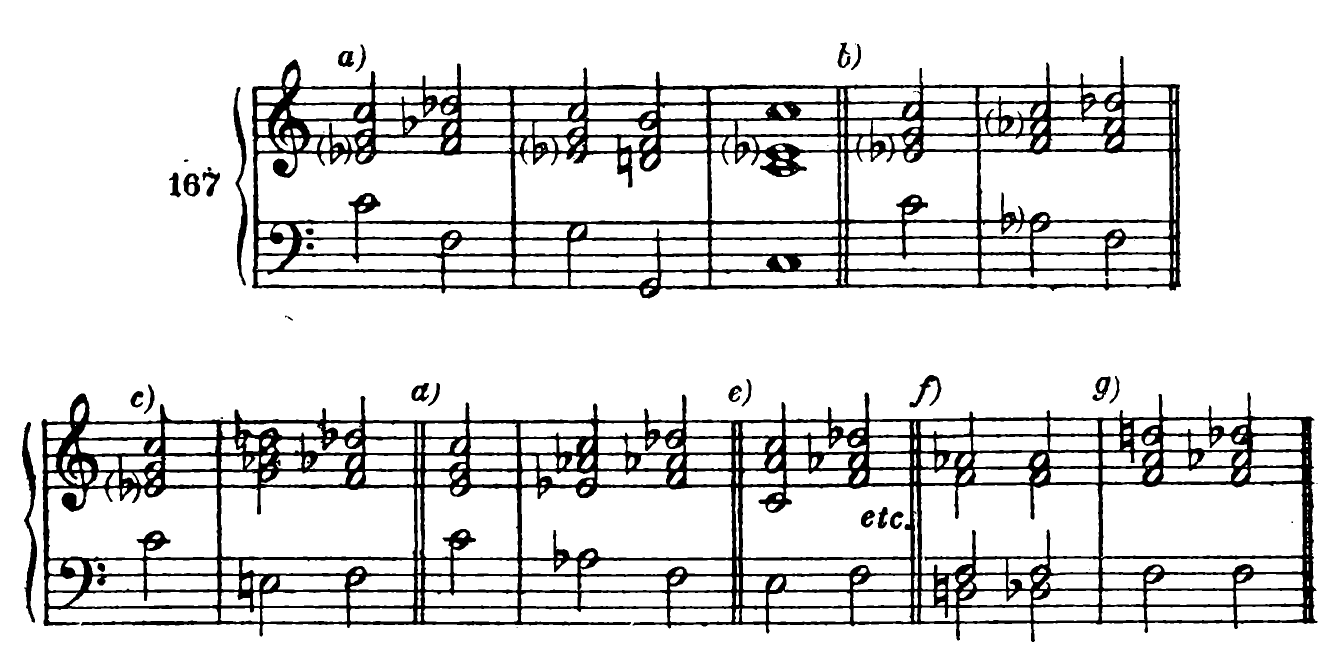 ▶ Example 167a
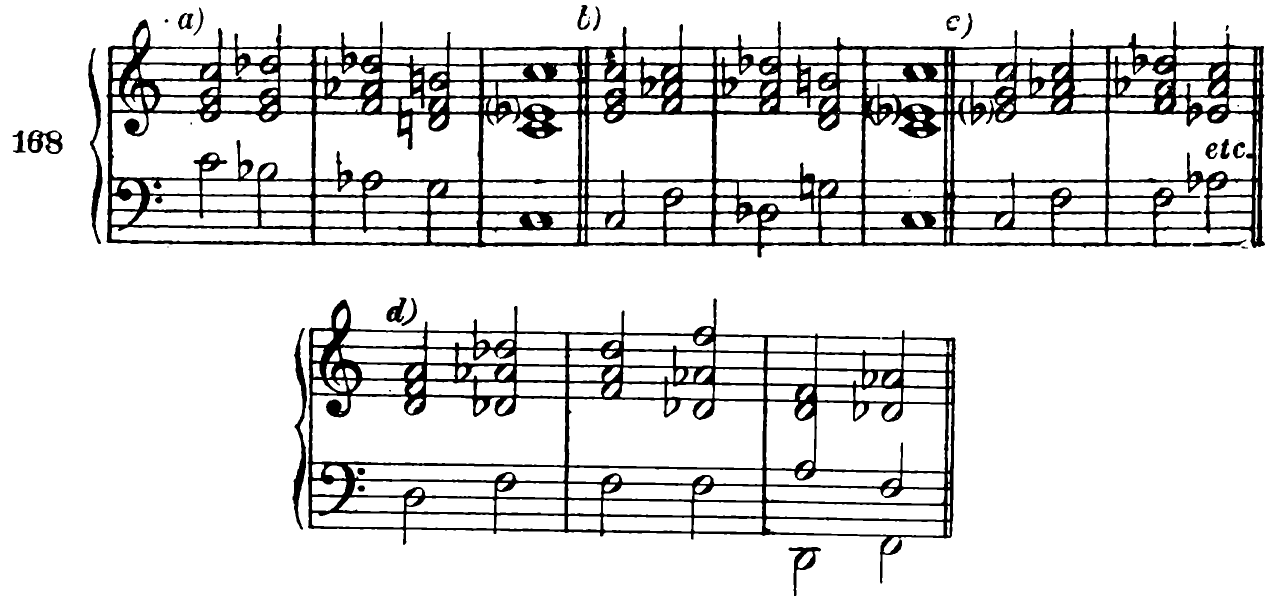 ▶ Example 168a
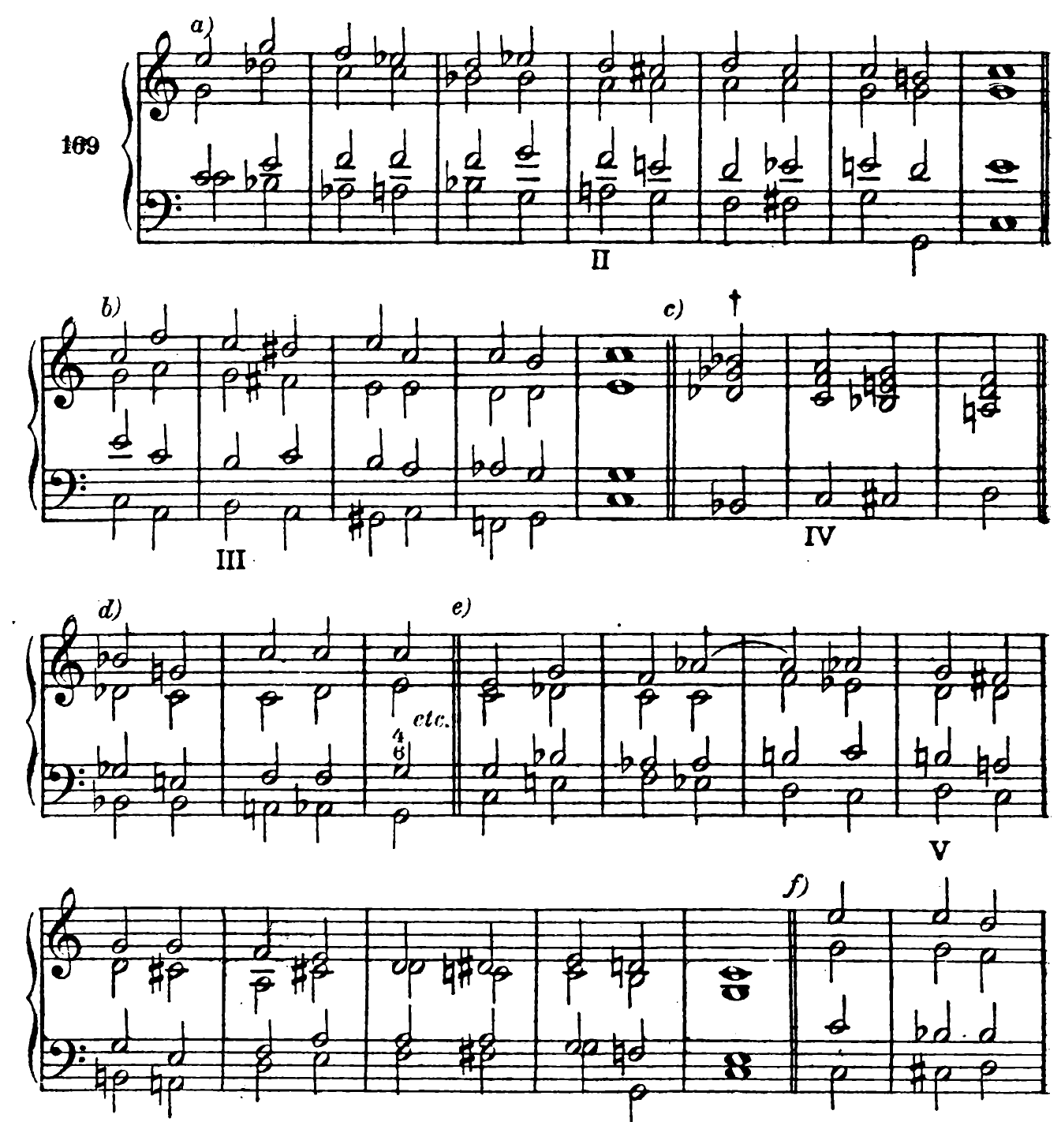 ▶ Example 169a
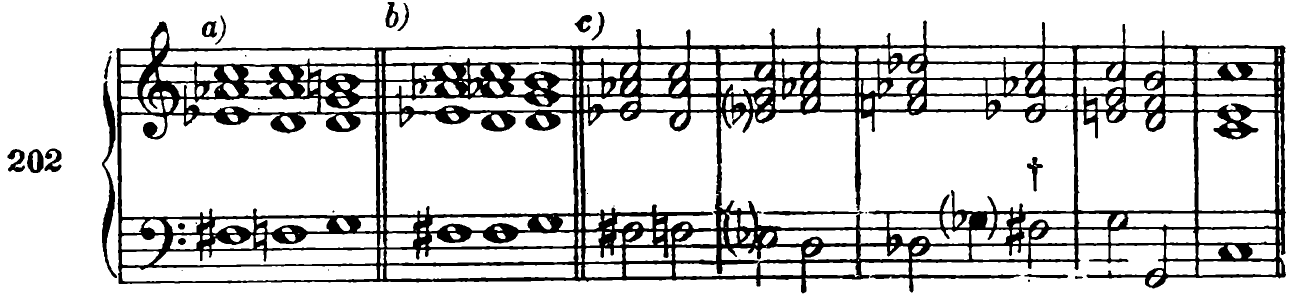 ▶ Example 202a
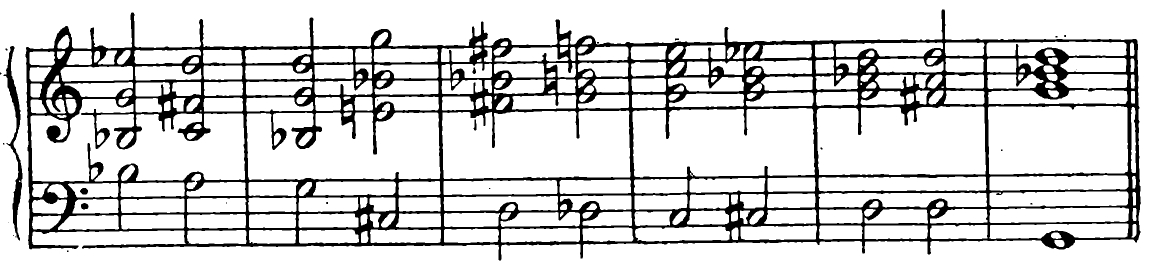 ▶ Example 210-b2
 OrchestrationCecil Forsyth, 1914
- No. 54. The Mandoline.'
Fr. Mandoline; It. Mandolino; Ger. Mandoline. This is a smail pear-shaped instrument with a fretted neck. It is furnished with eight wire-strings tuned in pairs. The actual tuning is now standardized by the Neapolitan makers is the same as that o the Violin:
- No. 54. The Mandoline.'
…than once. It has been suggested that, if he had really wished the ordinary Neapolitan Mandoline, he would have written phrases more characteristic of its special method -the reiterated tenuto. A decision on this point is difficult, though if the Mandoline was…
More in Chords
Triads · Inversions and the chord of the sixth · The six-four chord · Seventh chords · The diminished seventh chord · Ninth chords · Augmented sixth chords · Secondary dominants · Borrowed chords (mixture)