 Playable Books
Concept index · Chords
Secondary dominants
Taught in 3 books. Each one opens at the passage; ▶ plays the example beside it. Also called secondary dominant, applied dominant, dominant of the dominant.
This index is Playable Books’ own: a first pass that finds the term’s words in each book, corrected by hand. The authors did not tag these passages, and their terms can differ (Fux’s “ligature” is a suspension). The quoted text is the book’s.
 Counterpoint AppliedPercy Goetschius, 1902
- Chapter XI
…tone of the Subject (ab). In a word, this initial g' is the Second-dominant (Dominant of the Dominant) in the key of f minor thus far pursued; and while this comparatively remote tone, or any other, can be reached in time, it is certain to sound abrupt at the…
▶ Fig. 320 nearby
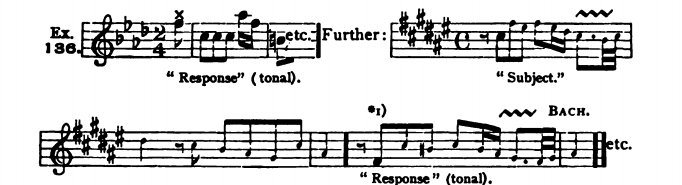 ▶ Ex136
 Guide to the Practical Study of HarmonyPyotr Ilyich Tchaikovsky, 1900
- Chapter XXII. The Organ-point
…harmonies of the main key, modulations into the key of the Dominant, the Dominant of the Dominant,—equivalent to the second degree and occurring mostly in minor—and the swb-Dominant. The Organ-point on the Dominant, being merely a prolongation of the ordinary…
▶ Fig. 214 nearby
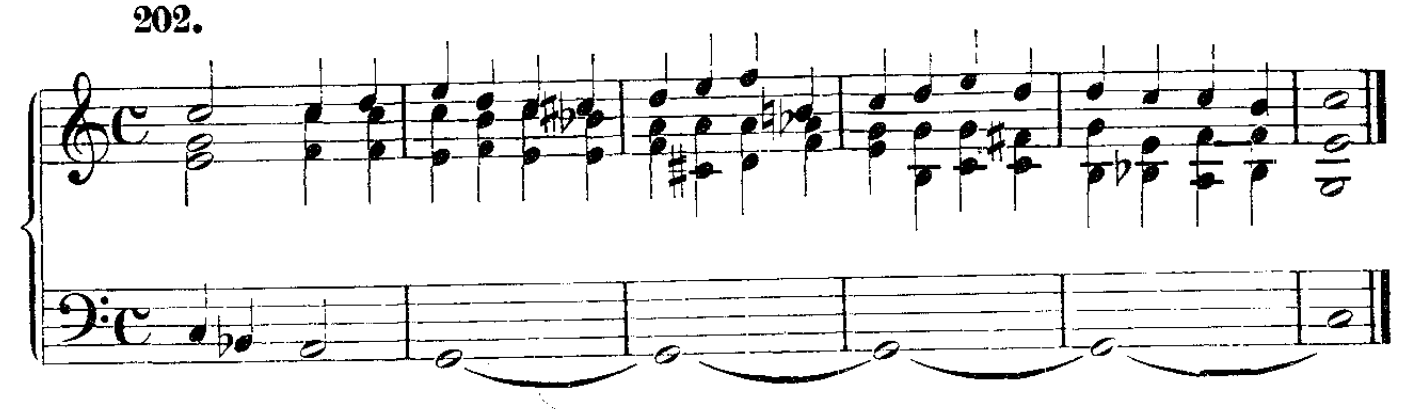 ▶ Fig. 214
 Theory of HarmonyArnold Schoenberg, 1922
Start: Secondary Dominants and Modal Chords →- Secondary Dominants and Modal Chords
…is that here a step resembling a deceptive cadence (II–I) is made from a secondary dominant. Such connections are naturally possible from other secondary dominants too. But the student will do well to be sparing with them, for otherwise he could easily write…
▶ Fig. 192 nearby - Secondary Dominants and Modal Chords
The modulation is then better made briefly, with a quick means. That the secondary dominants are likewise to be used in minor, and that no new laws arise in doing so, is clear. Only one thing should be said here in more precise form, which also holds for major…
▶ Fig. 201 nearby - Secondary Dominants and Modal Chords
…are diatonic chords of D major. Three mistakes have been made here: 1. Both secondary dominants used here lead (as the degree numbers show) into V degrees (of C major and of G major). 2. Both, the third as well as the sixth chord, are moreover themselves…
▶ Fig. 205 nearby - On the Diminished Seventh Chord
…draw on the alterations of the roots of the degrees, since they occur in the secondary dominants and there are actually seventh tones, by erecting, for example, on C-sharp (the third of the secondary dominant on A) a diminished seventh chord…
▶ Fig. 217 nearby - Augmented Sixth and Vagrant Chords
…the chord from the ninth chord on degree II in major or minor, by way of secondary dominants and the diminished seventh chord. It is then represented consistently in major and minor as follows: degree II in C major or minor; secondary dominant, secondary…
▶ Fig. 304 nearby - 8. Chromaticism and Tonality
…idea, 1–3–5, regulated and restricted by the requirements of the scale. Secondary dominants transfer the basic major triad to the secondary degrees, influenced by the model of the scale, whose seventh tone, as leading tone, is the third of a major triad. This…
83 more passages in Theory of Harmony →
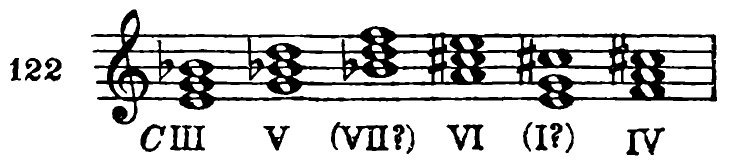 ▶ Example 122
Secondary Dominants and Modal Chords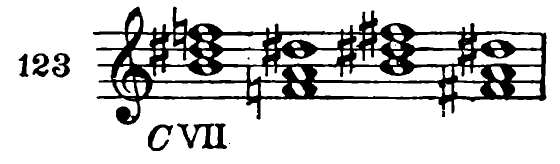 ▶ Example 123
Secondary Dominants and Modal Chords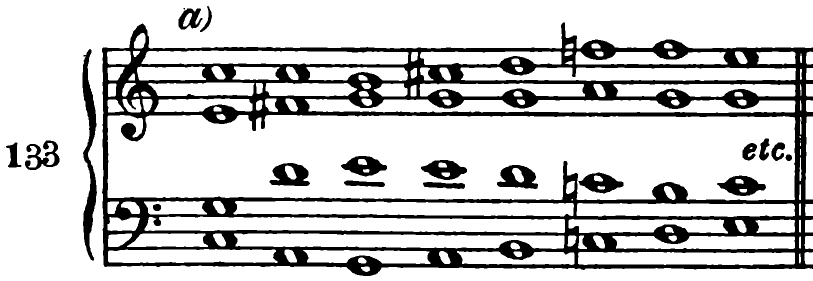 ▶ Example 133a
Secondary Dominants and Modal Chords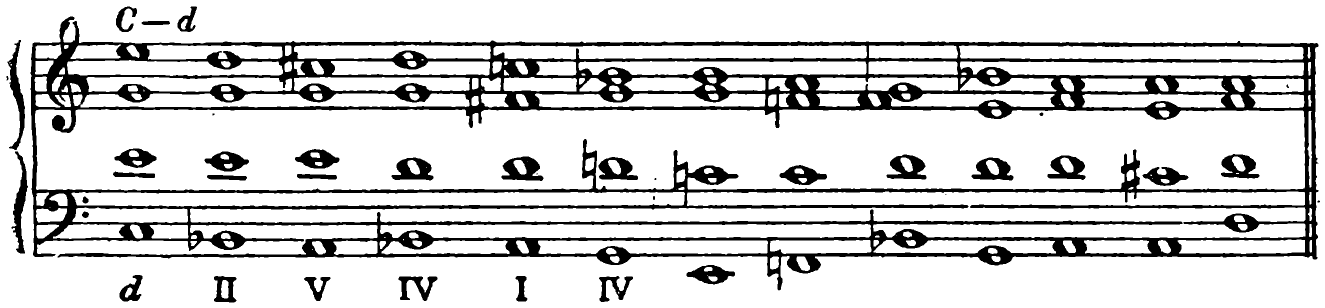 ▶ Example 134 (third system, C—d)
Secondary Dominants and Modal Chords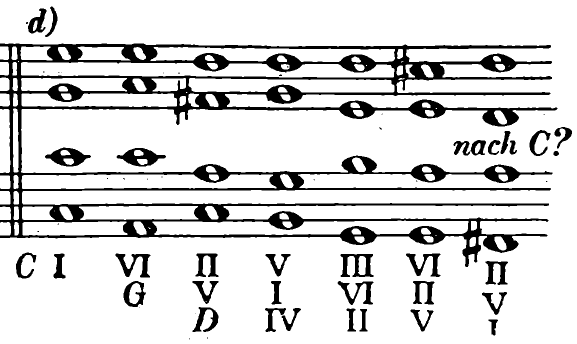 ▶ Example 135d
Secondary Dominants and Modal Chords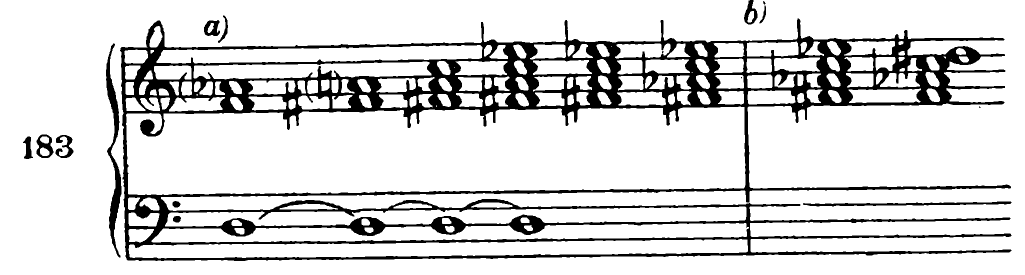 ▶ Example 183a
Augmented Sixth and Vagrant Chords
More in Chords
Triads · Inversions and the chord of the sixth · The six-four chord · Seventh chords · The diminished seventh chord · Ninth chords · The Neapolitan sixth · Augmented sixth chords · Borrowed chords (mixture)
All concepts · Search every passage for “secondary dominant”