 Playable Books
Concept index · Chords
Triads
Taught in 9 books. Each one opens at the passage; ▶ plays the example beside it. Also called triad, major triad, minor triad, diminished triad.
This index is Playable Books’ own: a first pass that finds the term’s words in each book, corrected by hand. The authors did not tag these passages, and their terms can differ (Fux’s “ligature” is a suspension). The quoted text is the book’s.
 Gradus ad ParnassumJohann Joseph Fux, 1725
- First species in three voices
…most complete of all is evident even from this: in it, a complete harmonic triad can be obtained without the help of another part, whereas the addition of a third part, or of further parts, is virtually nothing but the repetition of a part already present in…
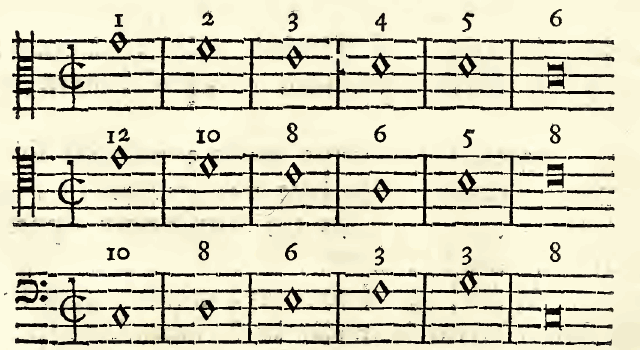
▶ Fig. 91 nearby - First species in three voices
First, observe that the harmonic triad should be used at every harmonic position, or measure, unless some other consideration prevents it.
▶ Fig. 91 nearby - First species in three voices
…calls for another consonance, either a sixth or an octave, in place of the triad. More often, the need to avoid two perfect consonances in immediate succession requires us to depart from the triad and use a sixth instead of the fifth, or an octave, or both. I…
▶ Fig. 92 nearby - First species in three voices
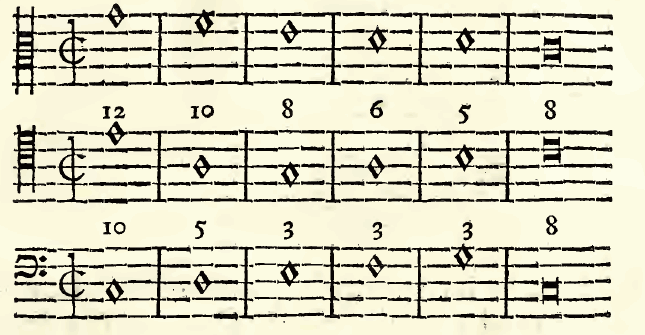
Joseph. With your permission, Master, I would say that the triad seems to have been omitted without reason in the second measure. In my judgment, the tenor could have been given a fifth, which would have completed the triad; and then, in the third measure, the…
▶ Fig. 93 nearby - Second species in three voices
…for this species in two voices, and what we said concerning the harmonic triad in semibreve against semibreve in three voices. There is this relaxation, however: in this species of three-voice composition, for the sake of the harmonic triad, a minim moving by…
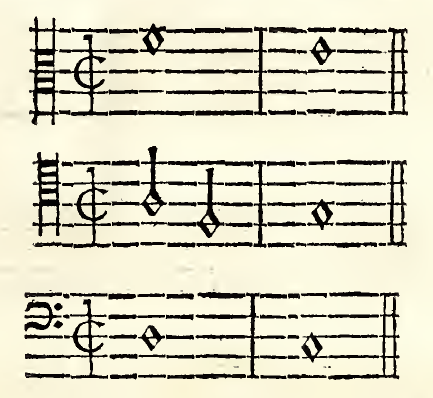
▶ Fig. 122 nearby - Fugue in three parts
…firmus: namely, that great consideration must be given to the complete triad. We must now see how a fugue for three parts is to be established and what must be observed in it. What was said of fugue for two parts also holds here until the time comes for the…
▶ Fig. 263 nearby
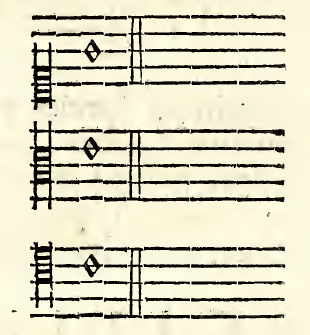 ▶ Fig. 91
 ▶ Fig. 92
 ▶ Fig. 93
 ▶ Fig. 122
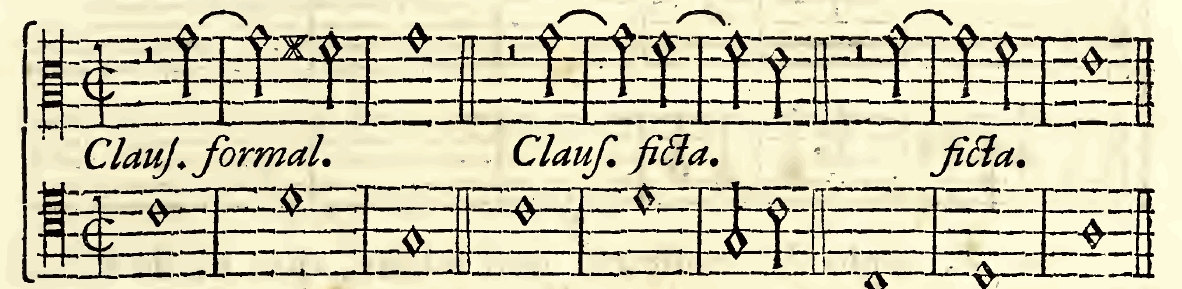 ▶ Fig. 263
 Exercises in Elementary CounterpointPercy Goetschius, 1910
- Chapter II. Wider Leaps
12. The "good " chords are the primary triads on scale-steps I, V, IV; also the II, though more rare; also the chords of the Dominant-7th and Dominant-gth. The chords on steps VI and III, and all subordinate dissonant chords, are too inferior to afford…
▶ Fig. 14 nearby - Chapter XVI. Three-Part Harmony
169. The following table shows how each one of the six triads may progress; that is, which chords may come after each:
▶ Fig. 281 nearby - Chapter XVI. Three-Part Harmony
After the V, — either the I, or the VI (which is the " parallel" triad of the I). Possibly the III.
▶ Fig. 282 nearby - Chapter XVI. Three-Part Harmony
The second inversion of any triad-form (the 6/4 chord) is rare and hazardous. It would be wise for the student to avoid all 6/4 chords, excepting the second inversion of the I, and of the IV. These are good.
▶ Fig. 283 nearby - Chapter XVI. Three-Part Harmony
Group 3 is doubtful, because of the inverted form of the VI. That triad is very rarely inverted. In group 4, the seventh of the chord (f in the upper part) remains where it is; this is always good, if the proper resolution follows. As already stated, the term…
▶ Fig. 285 nearby - Chapter XVIII. With Modulations
1. The first of the two chromatic tones may be harmonized with a triad, and the second tone with a Dom.-7th chord, or diminished-7th chord. Or,
▶ Fig. 319 nearby
 ▶ Ex.12
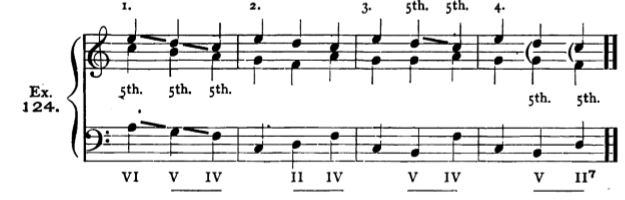 ▶ Ex.124
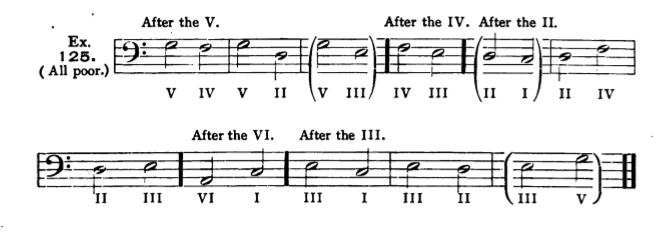 ▶ Ex.125
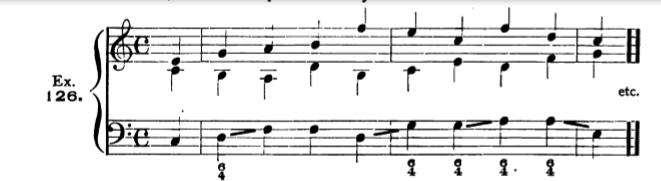 ▶ Ex.126
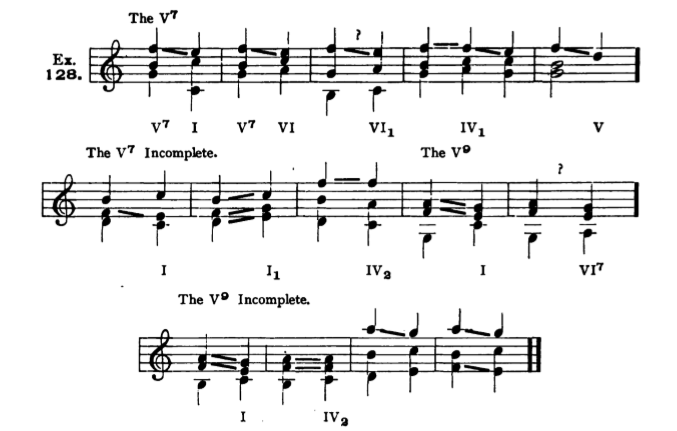 ▶ Ex.128
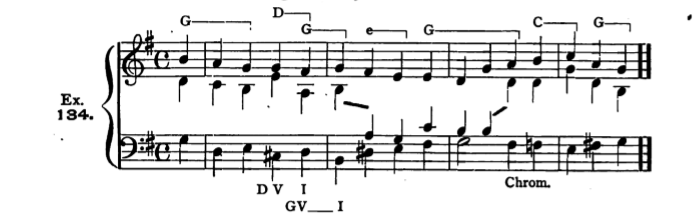 ▶ Ex.134
 Counterpoint AppliedPercy Goetschius, 1902
- Chapter II
b. The secondary consonances are : The perfect Sve, or unison; and those perfect 5ths which represent strong triads (those of the Tonic and Dominant).
▶ Fig. 64 nearby - Chapter II
d. Subordinate Triads (II, VI, III,) cannot progress into their respective principal Triads (IV-I-V) except by inverting the latter.
▶ Fig. 87 nearby - Chapter II
* Triad and 7th-chord on the Leading-tone. See the Author's " Mat. of Mus. Comp.," par. 187,
▶ Fig. 87 nearby - Chapter IV
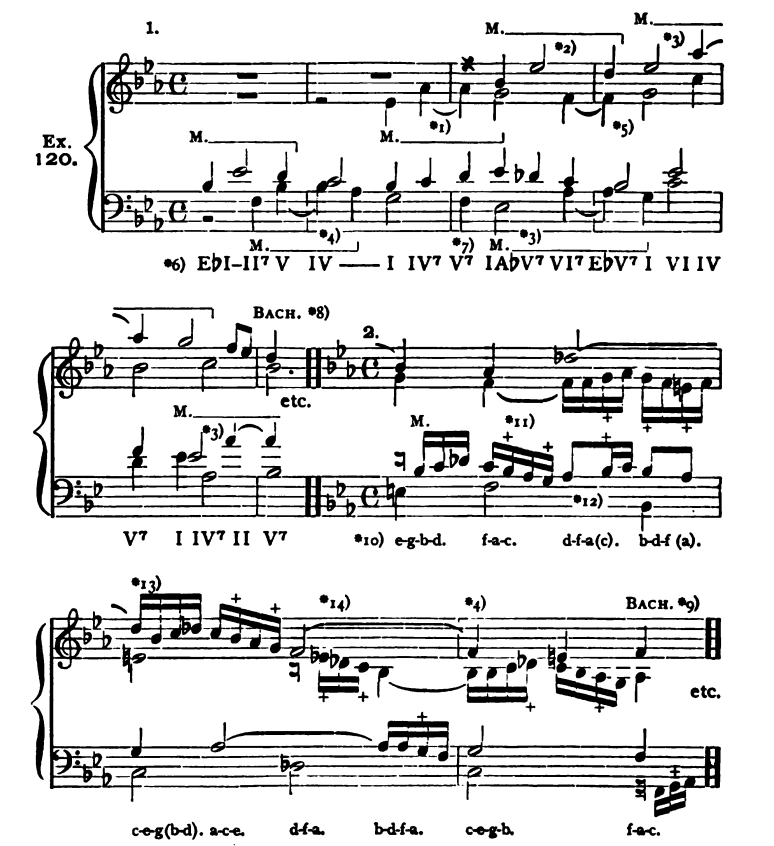
…aspect of the motive. In this case the original motive, which represents a "triad" form, is modified to a " chord of the seventh."
▶ Fig. 159 nearby - Chapter IV
At *3) the triad-form of the motive is changed, both by enlargement and contraction, to the form of a "chord of the sixth." At *4) it is changed to a chord of the seventh.
▶ Fig. 159 nearby - Chapter VIII
*#7) The Triad upon the Leading-tone (sometimes marked VII) is an abbreviated form of the Dominant 7th-chord.
▶ Fig. 261 nearby
 ▶ Ex38-3
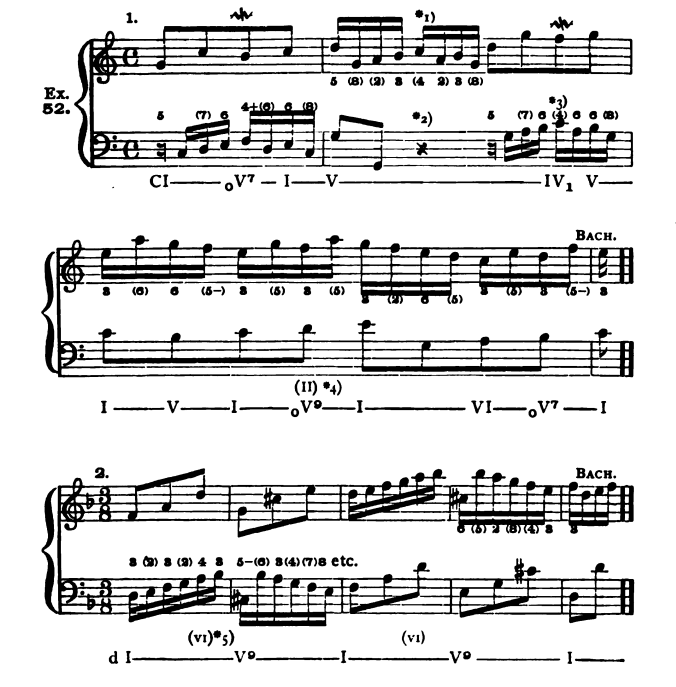 ▶ Ex52-1-2
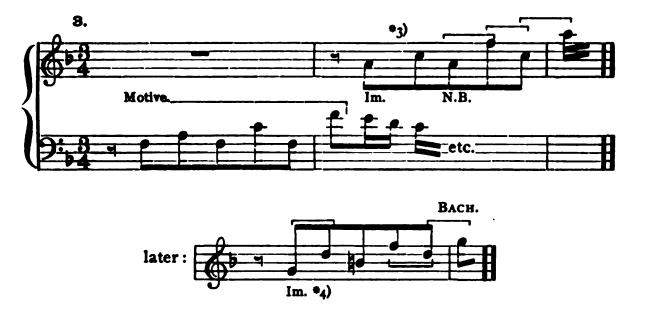 ▶ Ex70-A3
 ▶ Ex120
 Practical Manual of HarmonyNikolai Rimsky-Korsakov, 1910
Start: Triads → Start: The Sixth Chord of the Diminished-Fifth Chord of the Seventh Degree (*) → Start: The Augmented Fifth Chord (*) →- Triads · 10 playable examples
- Relationships between Triads · 3 playable examples
- Melodic Position of Triads · 6 playable examples
- Harmonic and Melodic Connection of Triads · 5 playable examples
- Connecting the Triads of I and IV, and of I and V, in Either Direction · 1 playable example
- Connecting the Triads of IV and V · 1 playable example
- Succession of Sixth Chords of the First, Fourth and Fifth Degrees with the Triads of the Same Degrees · 2 playable examples
- Succession of the Sixth Chord of the Fourth Degree with the Triad of the Fifth Degree · 1 playable example
- Succession of the Triad of the Fourth Degree with the Sixth Chord of the Fifth Degree · 1 playable example
- The Triad of the Second Degree in the Major Mode · 3 playable examples
- Twofold Use of the Triad of the Sixth Degree · 2 playable examples
- The Triad of the Third Degree of the Major Mode · 2 playable examples
- The Triad of the Third Degree of the Natural Minor Mode (Phrygian Cadence of the First Kind) · 2 playable examples
- The Triad of the Seventh Degree of the Natural Minor Mode (Phrygian Cadence of the Second Kind) · 3 playable examples
- 5 (Triad of IV with the sixth chord of V; sixth chord of IV with the triad of V) · 8 playable examples
- 13 (Triad and sixth chord of the second degree) · 4 playable examples
- 14 (Common chord of the sixth degree) · 15 playable examples
- Triads
§ 1. A triad (chord of three notes) is one formed of a root, a third and a fifth. According to the make-up of these intervals, triads fall into four kinds:
▶ Fig. 10 nearby - Triads
a) A triad formed of a major third and a perfect fifth — that is, a major third with a minor third above it — is called a major triad (accord parfait majeur).
▶ Fig. 10 nearby - Triads
b) A triad formed of a minor third and a perfect fifth — a minor third with a major third above it — is called a minor triad (accord parfait mineur).
▶ Fig. 10 nearby - Triads
c) A triad formed of a minor third and a diminished fifth — two minor thirds — is called a diminished triad (chord of the diminished fifth).
▶ Fig. 10 nearby - Twofold Use of the Triad of the Sixth Degree
1) The dominant triad, avoiding the tonic triad that ordinarily follows it, passes by melodic connection to the triad of the sixth degree, with the third doubled.
▶ Fig. 108 nearby - Twofold Use of the Triad of the Sixth Degree
1) The triad of the sixth degree is placed after the tonic triad, and then come the triads of the fifth, fourth and second degrees, or the sixth chord of the second degree.
▶ Fig. 109 nearby
97 more passages in Practical Manual of Harmony →
 ▶ The four kinds of triad on C: a) C–E–G, b) C–E♭–G, c) C–E♭–G♭, d) C–E–G♯
Triads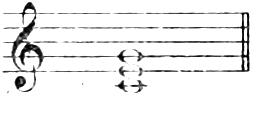 ▶ Triad in root position
Triads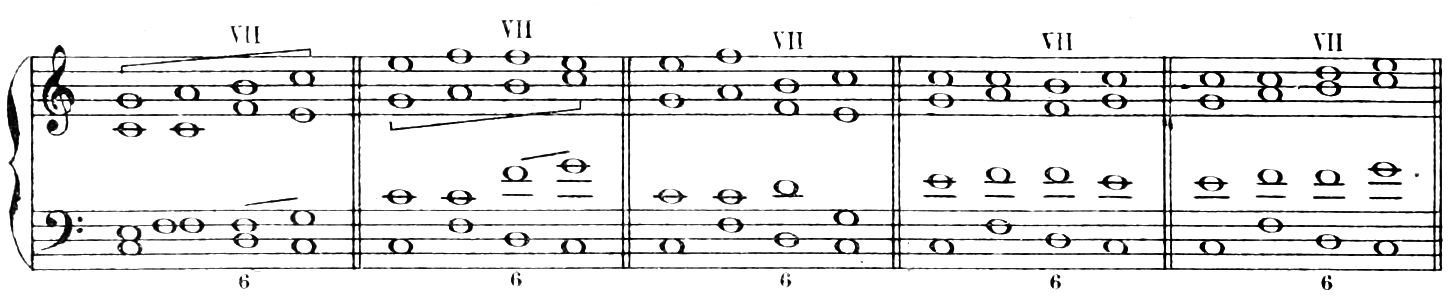 ▶ Five progressions in C major, I–IV–VII6–I, with the sixth chord of VII (figured 6) between IV and I; the leading note B rises to C
The Sixth Chord of the Diminished-Fifth Chord of the Seventh Degree (*)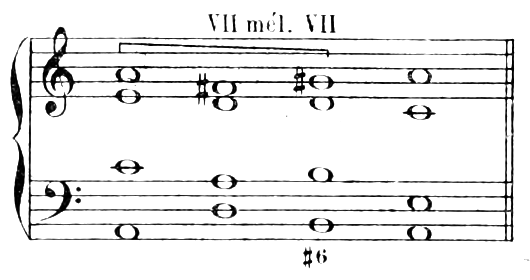 ▶ A minor: I – IV (melodic, D–F♯–A) – VII6 (figured ♯6) – I
The Sixth Chord of the Diminished-Fifth Chord of the Seventh Degree (*)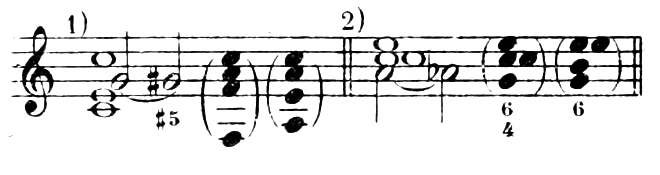 ▶ [Example]
The Augmented Fifth Chord (*)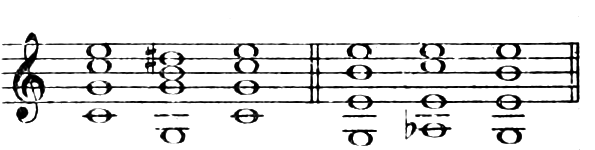 ▶ [Example]
The Augmented Fifth Chord (*)
 Guide to the Practical Study of HarmonyPyotr Ilyich Tchaikovsky, 1900
Start: Chapter I. The Triads of the Major Scale → Start: Chapter VI. The Harmony of the Minor Scale → Start: Chapter IX. The Inversions of the Diminished and Augmented Triads → Start: Chapter XXVI. Chords of the augmented Fifth →- Chapter II. The Connection of the Triads of the Major Scale · 4 playable examples
- Chapter III. Connection of Triads, showing no External agreement · 9 playable examples
- Chapter IV. Deviations from rules governing the connection of related Triads · 10 playable examples
- Chapter VIII. The Inversions of the Triad · 13 playable examples
- Chapter XIV. The connection of dissonant Harmonies resolving into the tonic Triad · 13 playable examples
- Introduction · Intervals
…Base—the intermediate tone: the Third—and the highest tone: the Fifth of the triad. Triads are divided, according to the kinds of Thirds and Fifths that compose them. A large or major triad is a chord composed of a major Third and a perfect Fifth (a). Minor…
▶ Fig. 9 nearby - Chapter I. The Triads of the Major Scale
The triad on the 1-st degree is termed the Tonic triad; the triad on the 4-th degree, the Subdominant triad; and the triad on the 5-th degree, the Dominant triad.
▶ Fig. 11 nearby - Chapter II. The Connection of the Triads of the Major Scale
§ 11. We have already mentioned (§ 6) the internal relationship of the triads of the scale. Now, there is still another and purely external connection of these triads, growing out of the tones they have in common. The triads c, e, g and g, b, d for instance…
▶ Fig. 16 nearby - Chapter XXVI. Chords of the augmented Fifth
It goes without saying, that the fifth of the augmented triad can never be doubled. In most cases this triad is regarded as the Dominant of the following triad; accordingly the augmented triad on the tonic is usually found before the sub-dominant, that of the…
▶ Fig. 281 nearby - Chapter XXVI. Chords of the augmented Fifth
§ 95. Since the augmented triad consists of two major thirds erected one on the other, each triad is (as in the case of the diminished Seventh chord) the enharmonic equivalent of two other augmented triads, so that its inversions can, by enharmonic alteration…
▶ Fig. 286 nearby - Chapter XXIX. Strict Part-writing
…between the Bass and the other voices; consequently it admits only major and minor triads with their first inversions, and the chord of the sixth of the diminished triad. The fourth being regarded as a dissonance, chords of the sixth and fourth are excluded.…
▶ Fig. 323 nearby
179 more passages in Guide to the Practical Study of Harmony →
 ▶ Fig. 10
Chapter I. The Triads of the Major Scale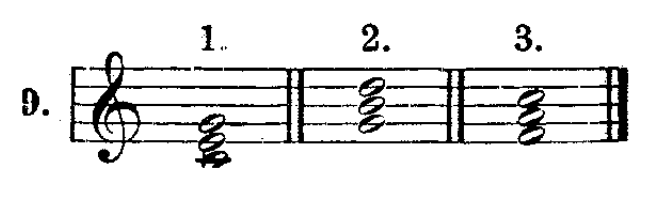 ▶ Fig. 11
Chapter I. The Triads of the Major Scale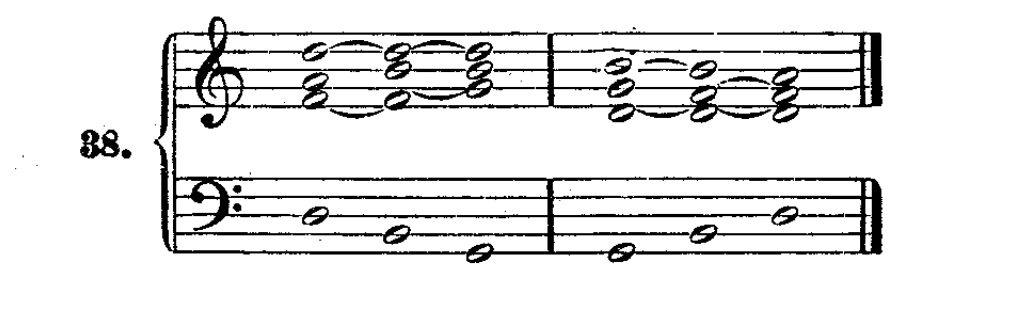 ▶ Fig. 41
Chapter VI. The Harmony of the Minor Scale ▶ Fig. 42
Chapter VI. The Harmony of the Minor Scale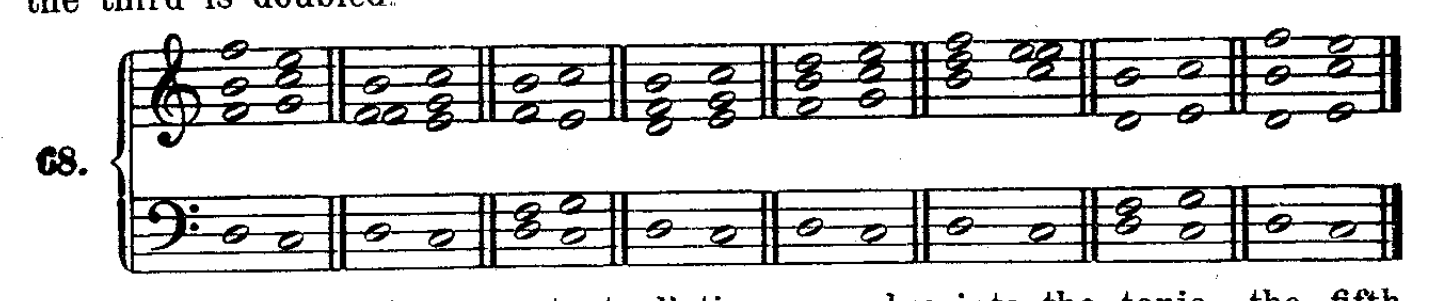 ▶ Fig. 71
Chapter IX. The Inversions of the Diminished and Augmented Triads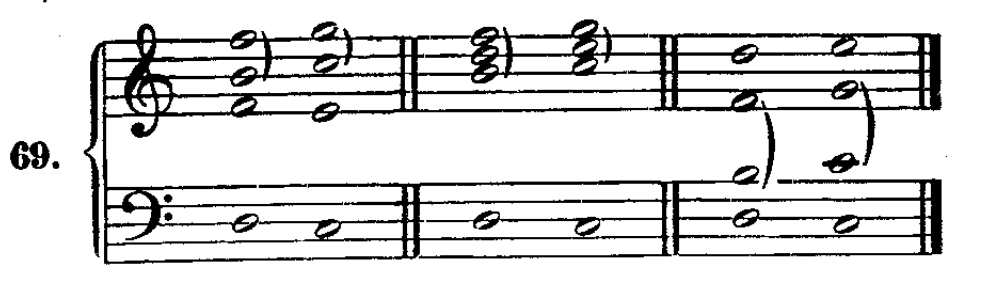 ▶ Fig. 72
Chapter IX. The Inversions of the Diminished and Augmented Triads
 Supplement to the Theory of ModulationMax Reger, 1904
- From C-major · Footnote
Small letters always indicate the minor key, or minor triad. Capital letters always indicate the major key, or major triad.
▶ Fig. 20 nearby - From C-major · Footnote
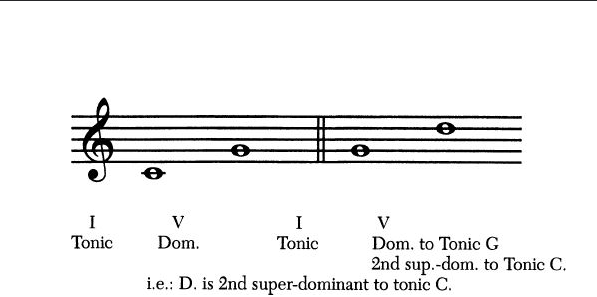
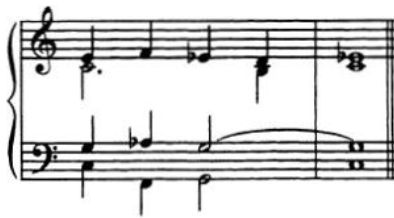
The 2nd super-dominant is in major and minor keys always a major triad and generally takes the place of the sub-dominant; hence the cadence in C-major with 2nd super-dominant.
▶ Fig. 30 nearby - From C-major · Footnote
The Dorian sixth is the major sixth in minor, which must always be led upwards (to the leading tone); for instance, f♯ in a-minor; this f♯ can be taken as the “Third” in D-major and also as the “Fifth” in the b-minor triad! (Hence D-major and b-minor: Chords…
▶ Fig. 70 nearby - From a-minor
Tonic a-minor; 1st inversion (chord of the sixth) of the diminished triad (g♯ b d) (aVII); translate this chord of the sixth (b d g♯), to f♯II (diminished triad g♯ b d [1st inversion] [in f♯-minor] on the 2nd degree). (Cadence!)
▶ Fig. 101 nearby - From a-minor
Tonic a-minor; 1st inversion (chord of the sixth) of the diminished triad (g♯ b d) (aVII); use this chord of the sixth, which is also f♯II (1st inversion!); tonic f♯-minor; use this f♯-minor, which is at the same time the sub-dominant of c♯-minor. (Cadence!)
▶ Fig. 103 nearby - From a-minor
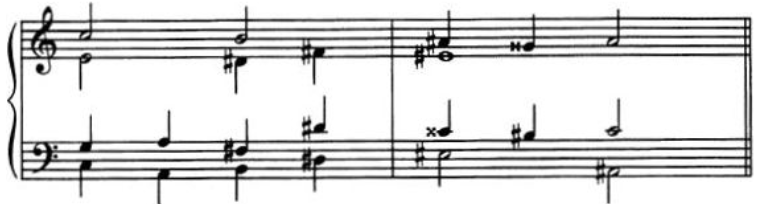
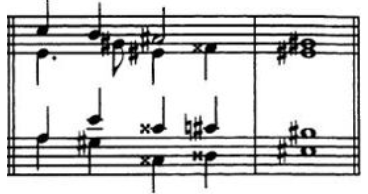
Tonic a-minor; dominant E-major (1st inversion); use this chord of the sixth (g♯ b e), which is at the same time the chord of the Neapolitan sixth in d♯-minor; dominant (A♯-major) of d♯-minor; use this triad (a♯ c𝄪 e♯), which is also the chord of the Dorian…
▶ Fig. 111 nearby
 ▶ Ex-10
 ▶ Extra-p32
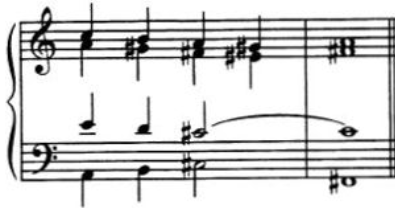
 ▶ Ex-34
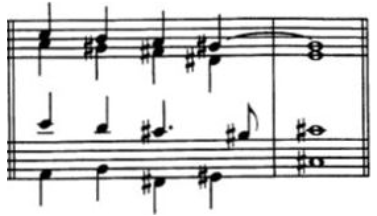
 ▶ Ex-49
 ▶ Ex-50
 ▶ Ex-54
 Theory of HarmonyArnold Schoenberg, 1922
Start: The Diatonic Triads → Start: Degree VII → Start: The Augmented Triad →- Connecting Primary and Secondary Triads · 1 playable example
- Inversions of triads · 1 playable example
- Connecting Triads and Sixth Chords · 11 playable examples
- Diatonic triads in minor · 14 playable examples
- Inversion of triads in minor · 3 playable examples
- 3. Combining Triads and Seventh Chords · 32 playable examples
- The Diatonic Triads
…tones of the scale, insofar as they are roots—that is, the lowest tones of a triad—are called degrees. Thus C in the triad c–e–g is the first degree, D in the triad d–f–a the second degree, E in e–g–b the third degree, and so forth. The triads differ in their…
▶ Fig. 6 nearby - Degree VII
The triad on degree VII, the diminished triad, requires special consideration. Its construction differs from that of the triads considered so far, which share at least one feature: the perfect fifth. The triad on degree VII has a diminished fifth; such a fifth…
- “Nonharmonic” Notes
…in examples. Names could also be found. One might, for instance, call a C-major triad with a “foreign” D-flat a “minor 1/2 major triad,” with a foreign D-natural a “major 1/2 major triad,” with E-flat a “double-third triad,” with F a “minor 3/4 major triad,”…
▶ Fig. 439 nearby - 1. Altered Chords
By lowering the third and raising the root in the major triad, or raising the root in the minor triad: 283a. Lowering the fifth and raising the root in the major triad; lowering the fifth and raising the third and root in the minor triad: 283b. Lowering the…
▶ Fig. 489 nearby - 8. Chromaticism and Tonality
…model: the tone. The faithful but incomplete vertical reproduction, the major triad, together with the scale, generates another, more distant reproduction: the minor triad. The remaining diatonic chords are then explained as reproductions of the triad's idea,…
- Subject index
Triads, primary and secondary 26, 28, 35 f., 150 f. (guidelines for their use), 213 note, 215 ff.; diatonic triads 34; connections of triads 43 ff., 47 ff., 87 ff., 434 ff.; triads in minor 122 ff., 217, 232 (guidelines for use of the artificial minor triad);…
 ▶ Example 1
 ▶ Example 12a
 ▶ Example 13a
 ▶ Example 174 a
 ▶ Example 175 a
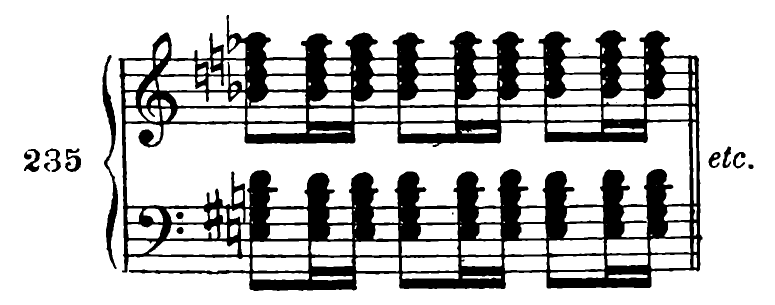 ▶ Example 235 — Mahler
 OrchestrationCecil Forsyth, 1914
- No. 11. The Kettle-Drums
…fifth, a tuning can be arranged that gives a harmony note to each of 18 triads (major and minor) out of a possible 24.
- No. 20. The Valve Horn' in F
…especially in chromatic music when it is supporting chords _other than common chords, it has a tendency to drop out of sight. In cases of this sort it is as well to add a Bassoon or Bass-Clarinet to the 4th part, but this adds a totally new tone-colour, and…
- Stringed instruments
Practically only major and minor triads and a few augmented fifths are available. They must be arranged either (1) with the fifth at the top and the sixth at the bottom, or (2) with the sixth at the top and the fitth at the bottom, or (3) with a sixth both at…
- Stringed instruments
Practically only a few major and minor triads and augmented fifths are available, all built on one or other of these two patterns,
- No. 49. The Cello
Triads and their inversions.
- No. 49. The Cello
All major and minor triads and their first and second inversions, provided the note
 Treatise on InstrumentationHector Berlioz, 1905
- The Viola d’Amore
…and viola. Since the seven open strings of the viola d’amore form a perfect common chord, it is very easy to produce rather rapid arpeggios of its basic chord, D, in the higher octave:
- The Organ
…the C-key produces also ¢, its fifth, octave, tenth, ete. Playing a C-major triad in this stop causes, therefore, the most awful nonsense, It is obvious that all these mixed stops may be used only—to reinforce, as it were, the harmonic partials—if the 8’, 4°,…
- The Bugle
…flourishes played on it. consisting exclusively of the three notes of the common chord. are necessarily of a boring uniformity bordering on vulgarity. The tone of this instrument is not very pleasant, it has no distinction, and it is hard to play on it in…
- The Melodium Organ
…with the mixture stops of the organ; for there the two other tone: of the common chord are heard at the same time (th major third and the fifth); but it remains crude jus the same.
More in Chords
Inversions and the chord of the sixth · The six-four chord · Seventh chords · The diminished seventh chord · Ninth chords · The Neapolitan sixth · Augmented sixth chords · Secondary dominants · Borrowed chords (mixture)