 Playable Books
Concept index · Chords
Ninth chords
Taught in 6 books. Each one opens at the passage; ▶ plays the example beside it. Also called ninth chord, dominant ninth.
This index is Playable Books’ own: a first pass that finds the term’s words in each book, corrected by hand. The authors did not tag these passages, and their terms can differ (Fux’s “ligature” is a suspension). The quoted text is the book’s.
 Treatise on HarmonyJean-Philippe Rameau, 1722
Start: Chapter thirty →- Table Explaining Essential Terms
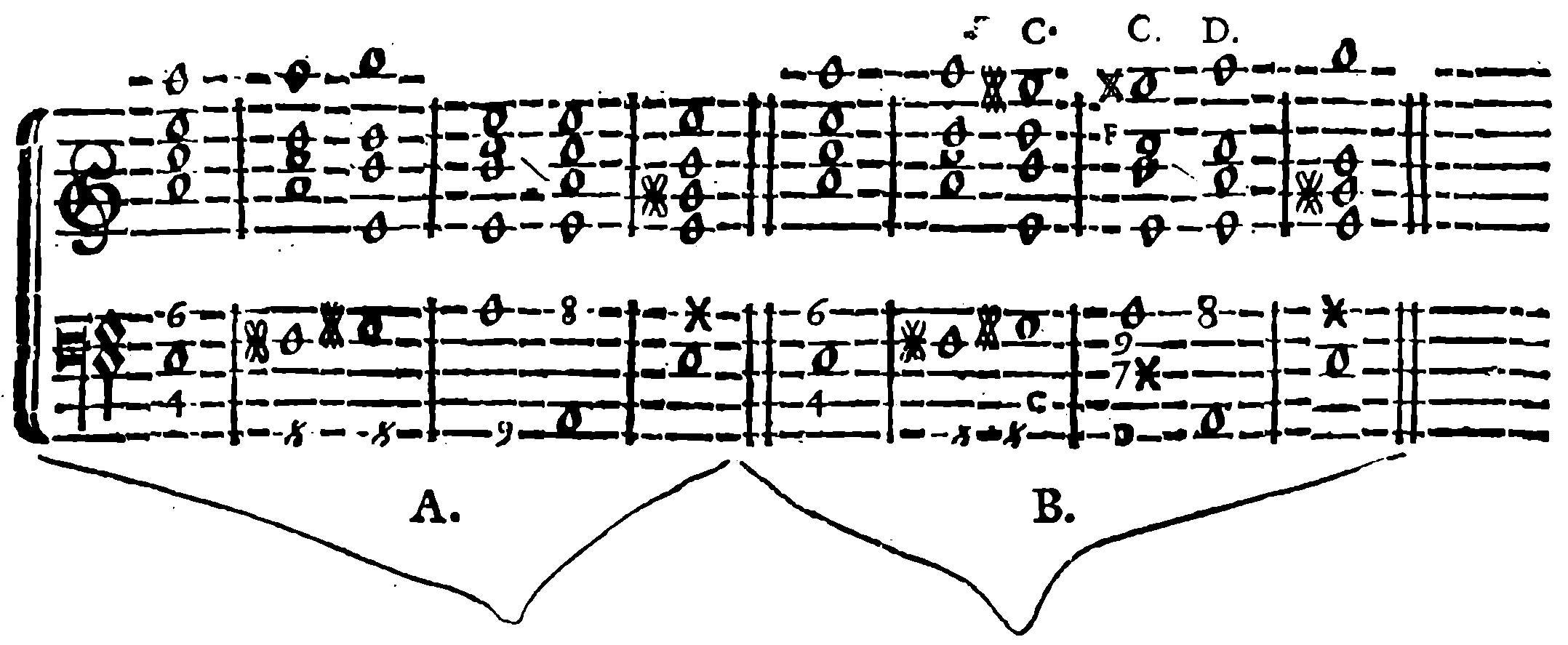
When a ninth chord sounds above a tonic, avoid adding the seventh. 94
- Table Explaining Essential Terms
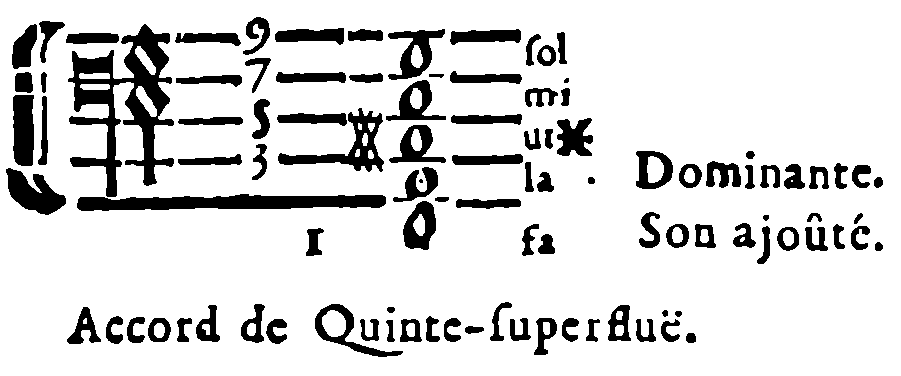
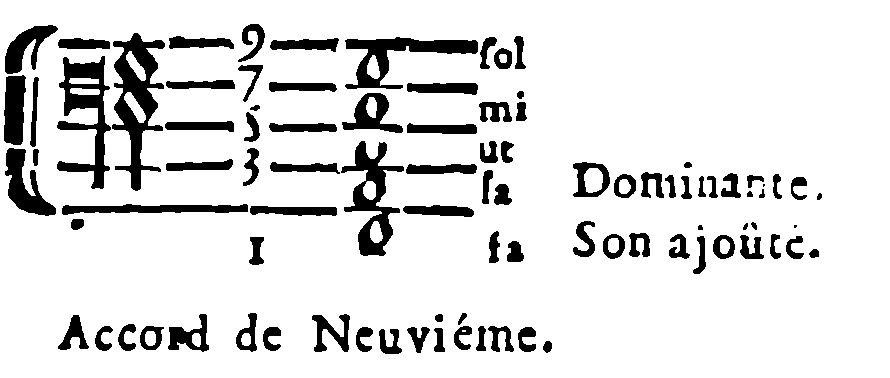
The squares on page 38 cannot accommodate the ninth chord’s supernumerary sound. This sound lies immediately beneath the fundamental and therefore supposes it.
- Chapter fifteen
Although our observations in Chapter X suggest that the seventh should always be part of the ninth chord, it is nevertheless unsuitable when that ninth chord occurs on a tonic. Here is the reason.
▶ Fig. 75 nearby - Chapter fifteen
…observe that this seventh is always augmented. As such, the chord is not a ninth chord but an eleventh chord, in which the third cannot occur. If the third replaces this eleventh, a ninth chord is then implied, and the seventh must no longer be considered…
▶ Fig. 75 nearby - Chapter seventeen
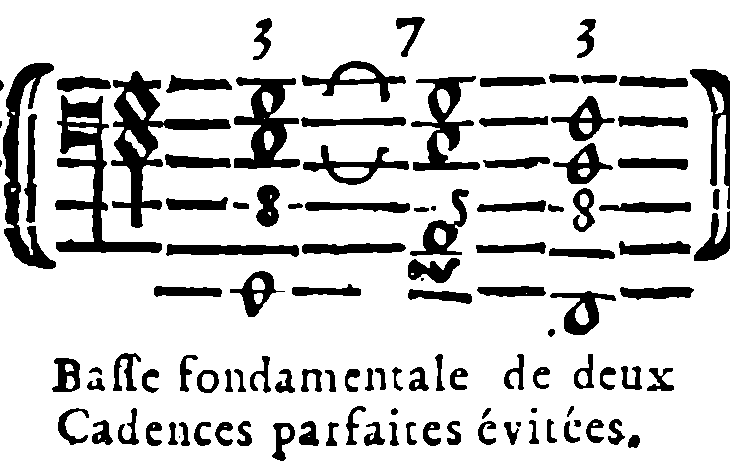
Had the ninth chord been considered as a whole in fixing its progression, either ninth-to-third resolution would have been forbidden or seventh-to-octave resolution allowed, since one cannot occur without the other. Had its origin also been considered, both…
▶ Fig. 86 nearby - Chapter forty-one
…The fundamental bass’s seventh chord shows that this note can bear only the ninth chord, though the ninth itself does not appear in the upper part. The fifth heard there belongs to that ninth chord, and the implied ninth is prepared and resolved according to…
▶ Fig. 323 nearby
 ▶ Fig. 75
 ▶ Fig. 86
 ▶ Fig. 274
 ▶ Fig. 275
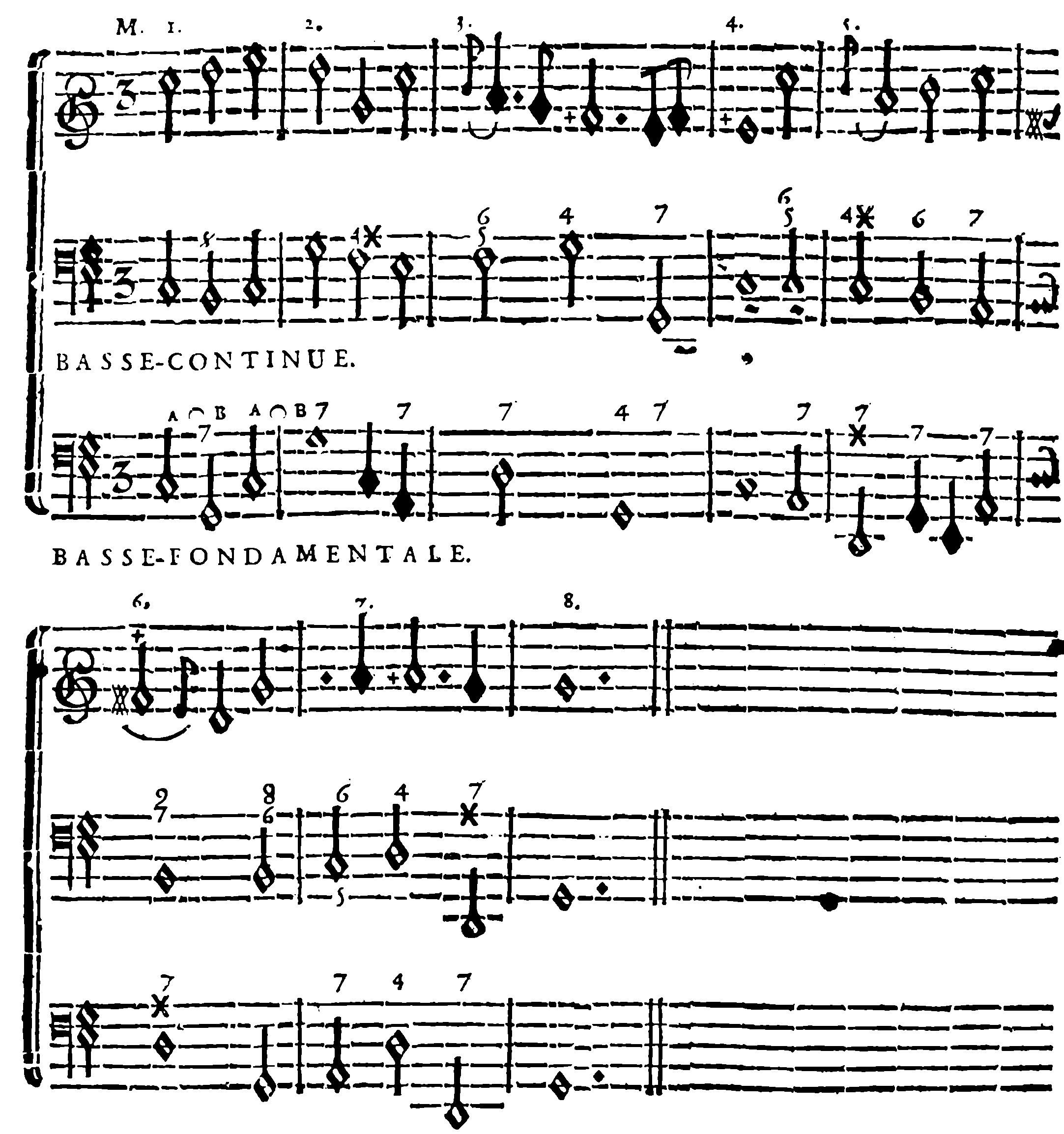 ▶ Fig. 323
 Practical Manual of HarmonyNikolai Rimsky-Korsakov, 1910
Start: Ninth chords →- Ninth chords
§ 42.—1) The ninth chord consists of a seventh chord with a further third added, a ninth above the bass.
▶ Fig. 145 nearby - Ninth chords
3) When the ninth is major it is called the major ninth chord; when the ninth is minor it is called the minor ninth chord.
▶ Fig. 145 nearby - Ninth chords
4) The major ninth chord is found on the fifth degree of the natural major mode, and the minor ninth chord on the fifth degree of the harmonic major and minor modes:
▶ Fig. 145 nearby - Ninth chords
5) To lay out the ninth chord in four parts, the fifth is omitted.
▶ Fig. 145 nearby - Ninth chords
7) The ninth chord is placed after the triad of the fourth degree, the two chords being connected harmonically, preferably with the ninth in the upper part:
▶ Fig. 146 nearby - Ninth chords
We give no special exercises for the use of this chord; the student will compose several examples of eight bars using the ninth chord without overusing it.
▶ Fig. 147 nearby
4 more passages in Practical Manual of Harmony →
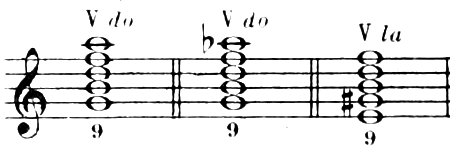 ▶ The ninth chord on the fifth degree: in C major with major ninth (G–B–D–F–A), in harmonic C major with minor ninth (A♭), and in A minor (E–G♯–B–D–F); each figured 9
Ninth chords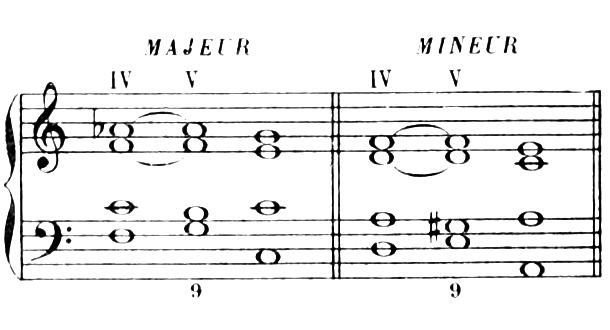 ▶ IV–V9–I in harmonic C major (ninth A♭) and iv–V9–i in A minor (ninth F), the common tones held, the ninth in the soprano resolving down to the fifth of the tonic
Ninth chords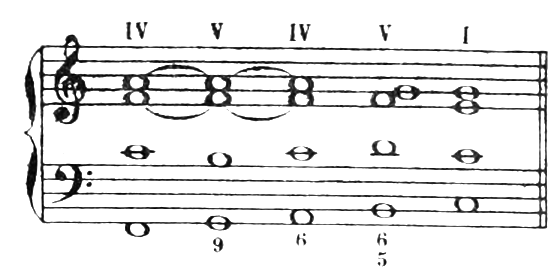 ▶ Ninth chord on V (9) as a passing chord between IV and IV6, then V6/5 – I, in C major
Ninth chords
 Guide to the Practical Study of HarmonyPyotr Ilyich Tchaikovsky, 1900
Start: Chapter XII. The chord of the Ninth →- Table of contents
Chapter XII. The chord of the Ninth — 40
- Chapter IX. The Inversions of the Diminished and Augmented Triads
Dissonant Harmonies, Chords of the Seventh and Chords of the Ninth.
▶ Fig. 77 nearby - Chapter XII. The chord of the Ninth
…chord contains, in major, a major ninth, and is therefore called the major chord of the ninth. In minor it contains a minor ninth—and is called the minor chord of the ninth. The chord of the ninth resolves into the tonic triad; the intervals already discussed…
▶ Fig. 98 nearby - Chapter XIII. Chords of the minor and diminished Seventh
As regards their resolution, these chords are treated as chords of the ninth without fundamental tone. Consequently their fundamental tone (the third of the chord of the ninth) is led one degree upward—their third (fifth of the chord of the ninth) one degree…
▶ Fig. 102 nearby - Chapter XIV. The connection of dissonant Harmonies resolving into the tonic Triad
¢) Repetitions of the chord of the ninth are rare; in minor they involve the exceedingly harsh step of the augmented second—from the 6-th to the 7-th degree. Often, however, the chord of the ninth is followed by the chord of the dominant-seventh, which…
▶ Fig. 115 nearby - Chapter XIX. Transient Modulation
…our disposal, we could construct such a sequence, consisting of a chain of chords of the ninth resolving into one. another; in four—part writing this is not practicable, since the ninth must be resolved into the fifth of the following chord; now, in a…
▶ Fig. 199 nearby
9 more passages in Guide to the Practical Study of Harmony →
 ▶ Fig. 77
Chapter IX. The Inversions of the Diminished and Augmented Triads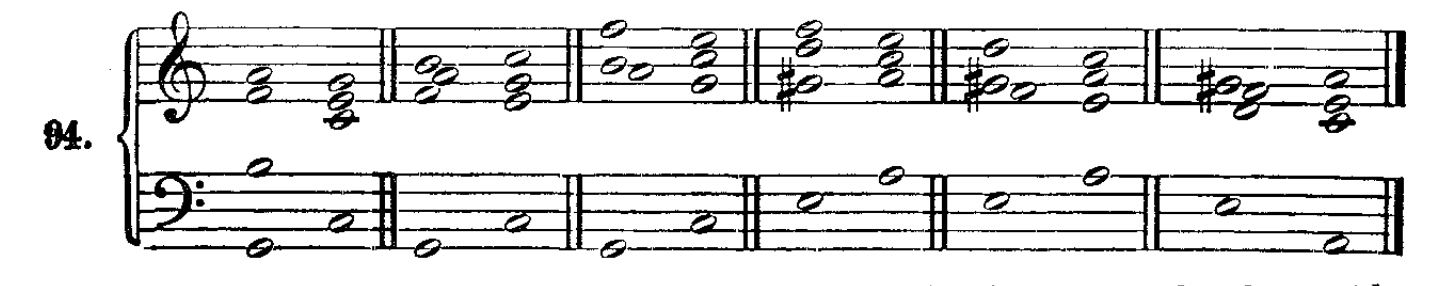 ▶ Fig. 98
Chapter XII. The chord of the Ninth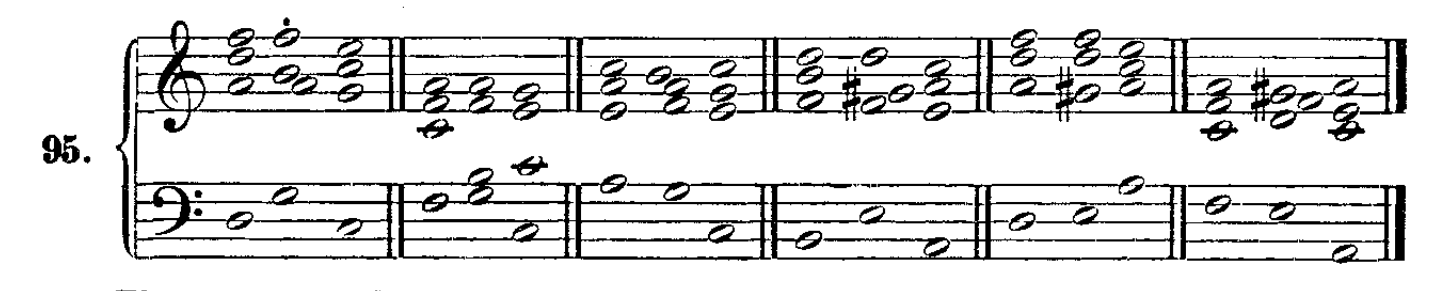 ▶ Fig. 99
Chapter XII. The chord of the Ninth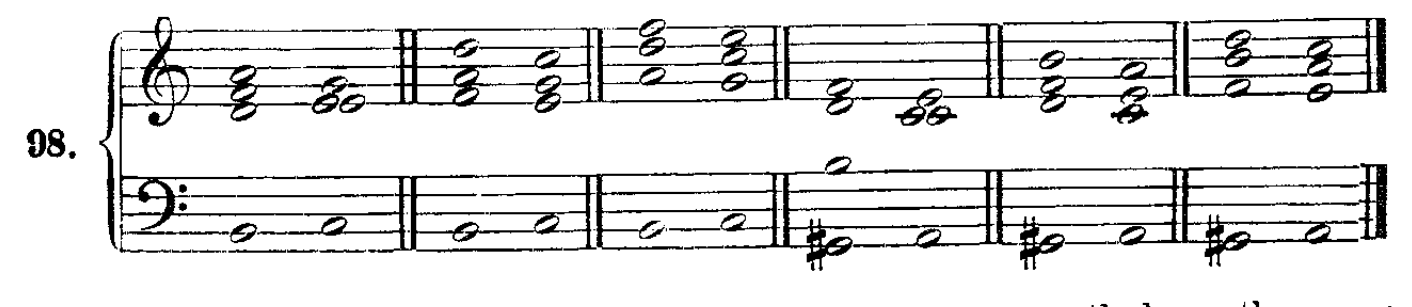 ▶ Fig. 102
Chapter XIII. Chords of the minor and diminished Seventh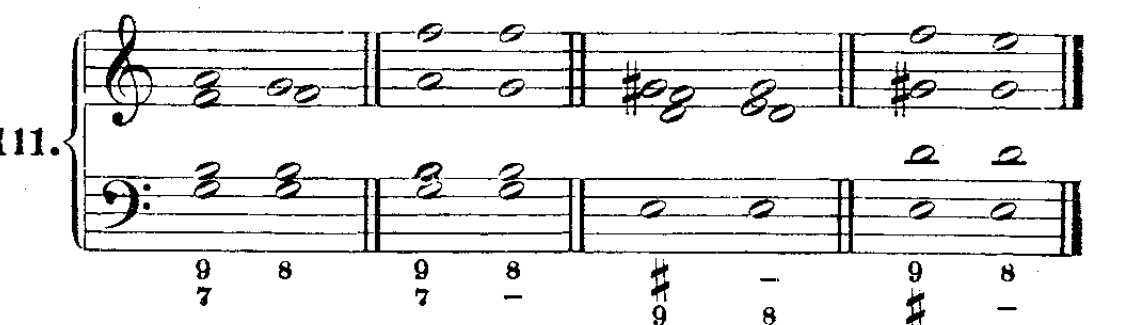 ▶ Fig. 115
Chapter XIV. The connection of dissonant Harmonies resolving into the tonic Triad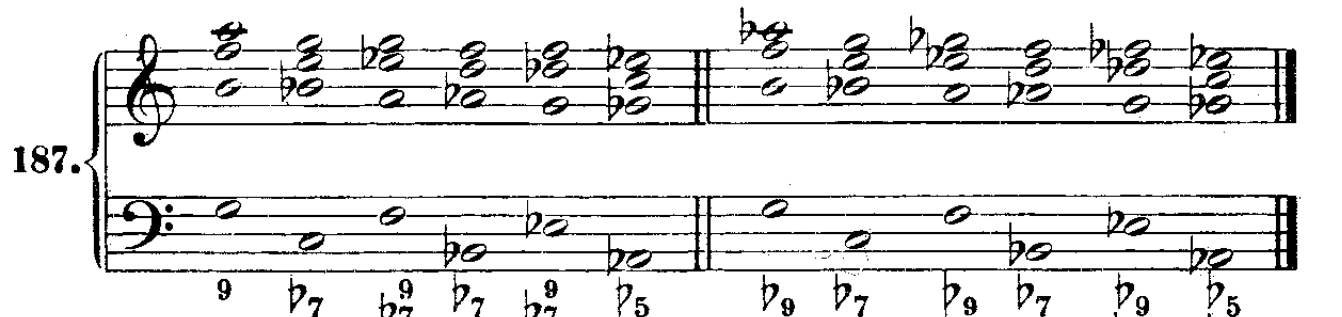 ▶ Fig. 199
Chapter XIX. Transient Modulation
 Theory of HarmonyArnold Schoenberg, 1922
Start: Some Remarks on Ninth Chords →- “Nonharmonic” Notes
…object: yes, but that happens only in passing. I say: the seventh chord and ninth chord also occurred only in passing before they were admitted to the system. Someone will say: seventh and ninth chords were not such harsh dissonances as these. I ask: how do…
▶ Fig. 436 nearby - Some Remarks on Ninth Chords
As far as I know, the chief objection to ninth chords is that their inversions are supposed to be unusable, and, I suspect, also the ridiculous obstacle that the chord cannot easily be presented in four-part writing; for its sake one would need five or six…
▶ Fig. 471 nearby - Some Remarks on Ninth Chords
…the reason given). Of course: there is no such thing as an inversion of a ninth chord; so there can be no performance of one either, for one surely cannot perform something that does not exist. And I had to wait a few years. However, when it was performed…
▶ Fig. 471 nearby - Some Remarks on Ninth Chords
But to prove the existence of the ninth chord it would really be enough, apart from the fact that it occurs as a suspension, to mention the dominant seventh-ninth chords with major or minor ninth, which nobody disputes. Even if one will not accept the ninth…
▶ Fig. 476 nearby - 1. Altered Chords
Example 289 presents alterations of the ninth chord, and 290 some possibilities for using them. I still adhere to letting the altered tone continue in the direction of its alteration. Just as a seventh chord can resolve deceptively, so naturally can a ninth…
▶ Fig. 519 nearby - 6. A Few More Small Matters
…seventh chord, are very familiar phenomena. E-flat as a suspension before a ninth chord is nothing new either (314b). Depending on the different roots to which this diminished seventh chord is referred (314c), the melody acquires a different meaning and…
▶ Fig. 601 nearby
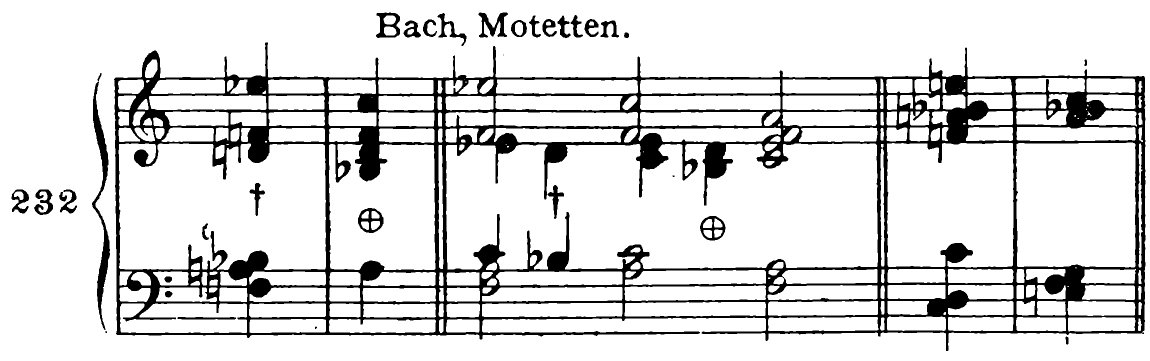 ▶ Example 232 — Bach, Motets
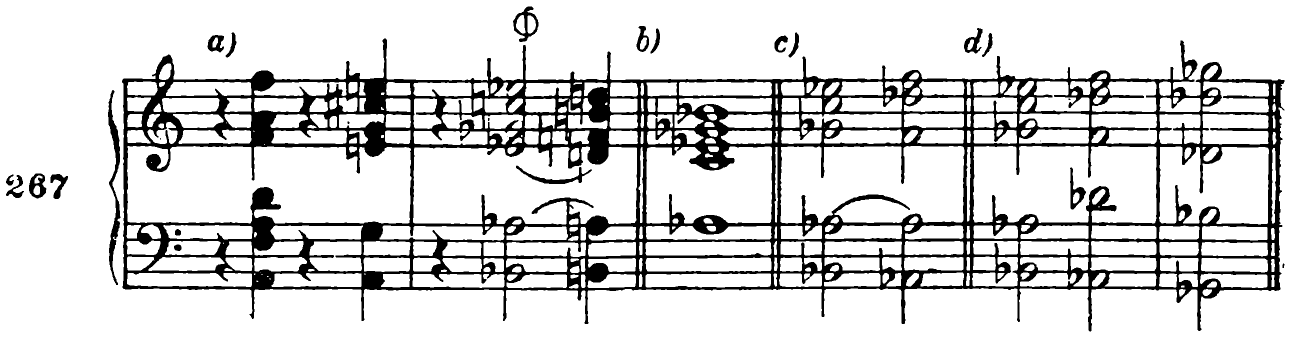 ▶ Example 267
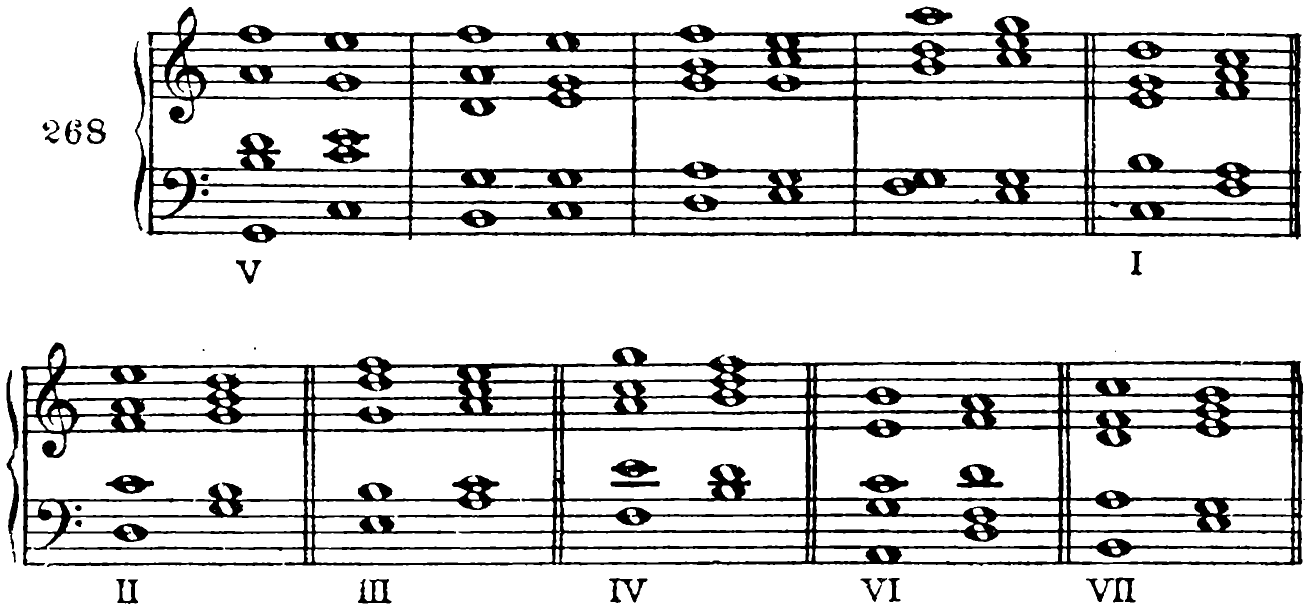 ▶ Example 268
 ▶ Example 271
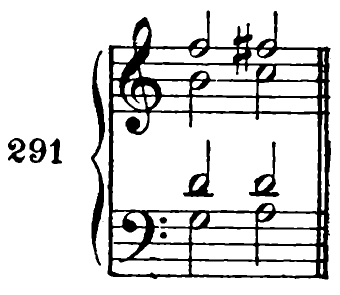 ▶ Example 291
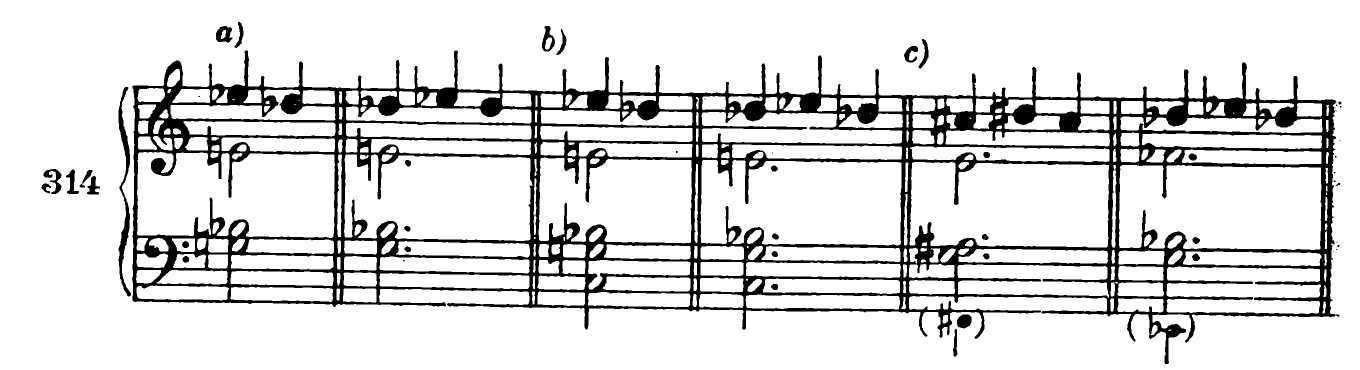 ▶ Example 314-a1
 OrchestrationCecil Forsyth, 1914
- No. 20. The Valve Horn' in F
…in the early days of the Valve-Horn-for the simple reason that, at the minor ninth chord, the only two open notes are those at the top.
- No. 49. The Cello
Dominant Ninths. None possible but these two:
- No. 52. The Harp
I'he most commonly used oi these chords are the parts of minor ninth chords usually known as "diminished sevenths, " but dominant sevenths and the upper portions of major ninths and elevenths are also available. In the following list the notes which are taken…
 Treatise on InstrumentationHector Berlioz, 1905
- The Double-Bass
together with the ninth-chord always gives me a sensation of color.
- The Harp
…impossible on the Ebharp are the following three seventh and three ninth chords, which must therefore be banned forever from the composer's store of harmonies:
More in Chords
Triads · Inversions and the chord of the sixth · The six-four chord · Seventh chords · The diminished seventh chord · The Neapolitan sixth · Augmented sixth chords · Secondary dominants · Borrowed chords (mixture)