 Playable Books
Concept index · Chords
Borrowed chords (mixture)
Taught in 8 books. Each one opens at the passage; ▶ plays the example beside it. Also called mode mixture, modal mixture, borrowed chord, harmonic major.
This index is Playable Books’ own: a first pass that finds the term’s words in each book, corrected by hand. The authors did not tag these passages, and their terms can differ (Fux’s “ligature” is a suspension). The quoted text is the book’s.
 Gradus ad ParnassumJohann Joseph Fux, 1725
- Double counterpoint at the twelfth
…subjects and depart from the use of double counterpoint? Without such a mixture of subjects, a composition, especially an ecclesiastical one, becomes simple and lacks its greatest ornament.
▶ Fig. 380 nearby
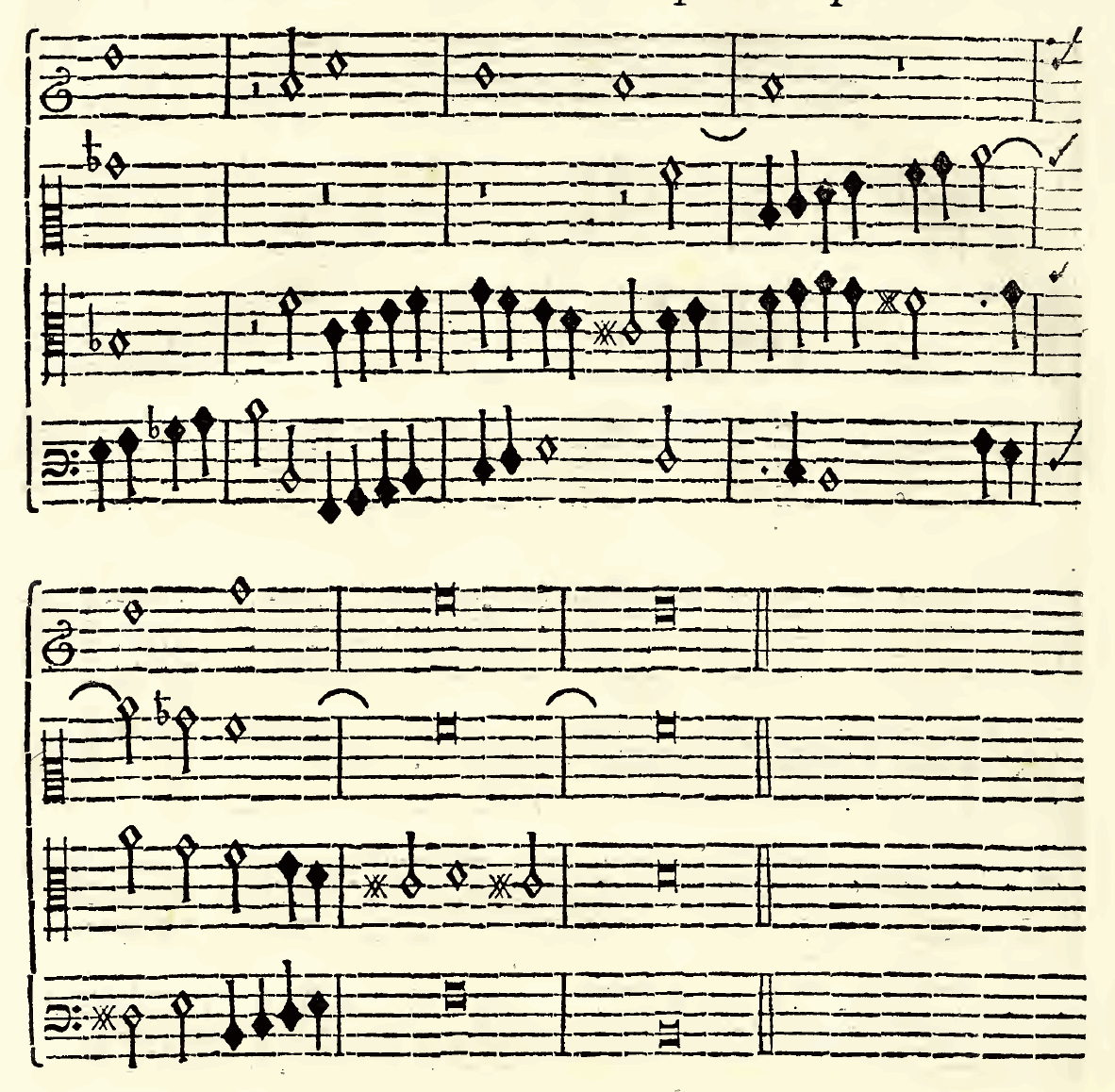 ▶ Fig. 380
 Counterpoint AppliedPercy Goetschius, 1902
- Chapter IX
…thought absolutely, and many intermediate varieties exist, in which a mixture (or the alternation) of the two ruling purposes is exhibited. Thus, the Invention may very gradually deteriorate from its original polyphonic rank, — as the thematic treatment…
- Chapter IX
…musical forms which are neither definitely homophonic nor polyphonic, but a mixture of both; partaking of the characteristics of the Invention, the Prelude, and the Fantasia, though not strictly to be classified as any of these.
- Chapter IX
87. A mixture of the polyphonic and homophonic styles, of stil another kind, is obtained by introducing brief thematic imitations, oi complete thematic sections, into a composition of distinctly homophonic character and otherwise unalloyed homophonic texture.
- Chapter XIV
A beautiful and entirely defensible illustration occurs in Bach, Well-temp. Cl., Vol. II, Fugue 3; it is 3-voice, sectional form; the Exposition is in stretto, and Contrary motion (Subject in Bass, 1½ measure), ending in meas. 7; in Sec. II (meas. 7-11) the…
▶ Fig. 375 nearby
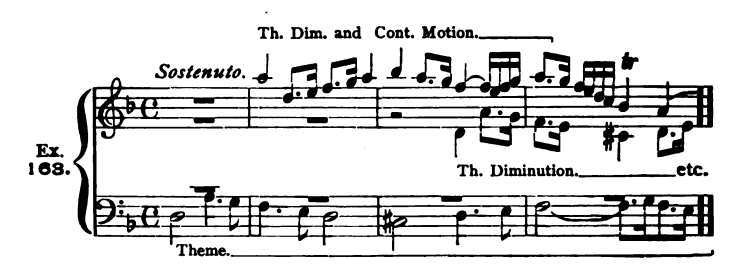 ▶ Ex163
 Treatise on HarmonyJean-Philippe Rameau, 1722
- CHAPTER TWELVE. On Borrowed Chords, with Which Perfect Cadences Can Be Avoided while Being Imitated · 2 playable examples
- Chapter seven
…composing this fifth and these thirds. Harmony invites us to this free mixture of sounds so that their diversity may make us feel more strongly the perfection of the whole; but this must not make us lose sight of a principle that always remains present. Now…
- Chapter seven
…augmented fifth, composed of only two major thirds, is tolerable only in a mixture of five different sounds, whose chord then exceeds the bounds of the octave, as we shall learn later.
- Chapter eighteen
4. With a borrowed chord, substitute the dominant for the sixth note in the fundamental bass. That sixth always forms an augmented second, or its inversion the diminished seventh, with the dominant’s major third. The remaining sounds then make a seventh chord…
- Chapter eighteen
…sound that may be implied, supposed, or borrowed. It also shows that borrowed chords occur only in minor keys, where the sixth borrows the tonic dominant’s foundation. That dominant must remain the fundamental bass even when supposition accompanies borrowing.…
▶ Fig. 98 nearby - Book III
…beat can also contain two, three, four, six, or eight equal notes, or any mixture of values equaling the chosen beat. The more notes per beat, the smaller their values must be. Thus the whole note cannot be worth less than one beat, and the others follow…
▶ Fig. 184 nearby
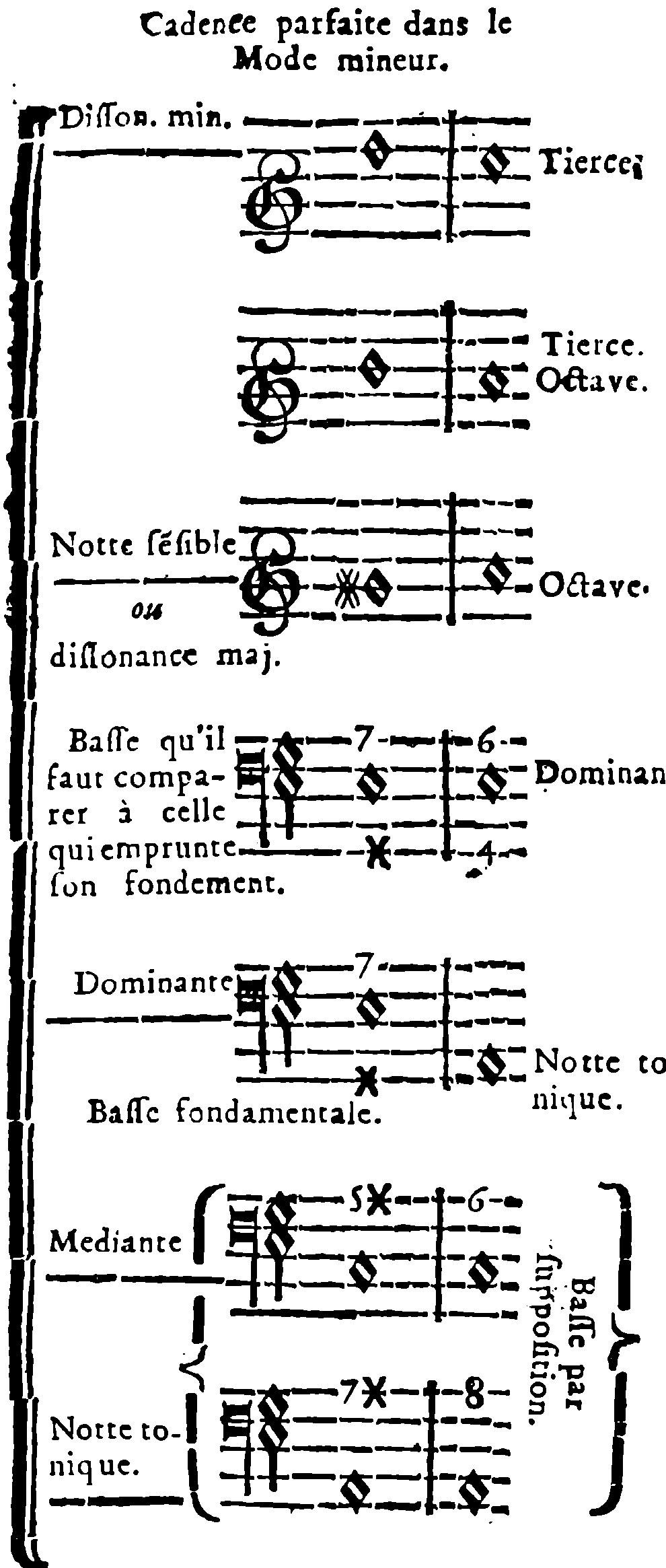 ▶ Fig. 55
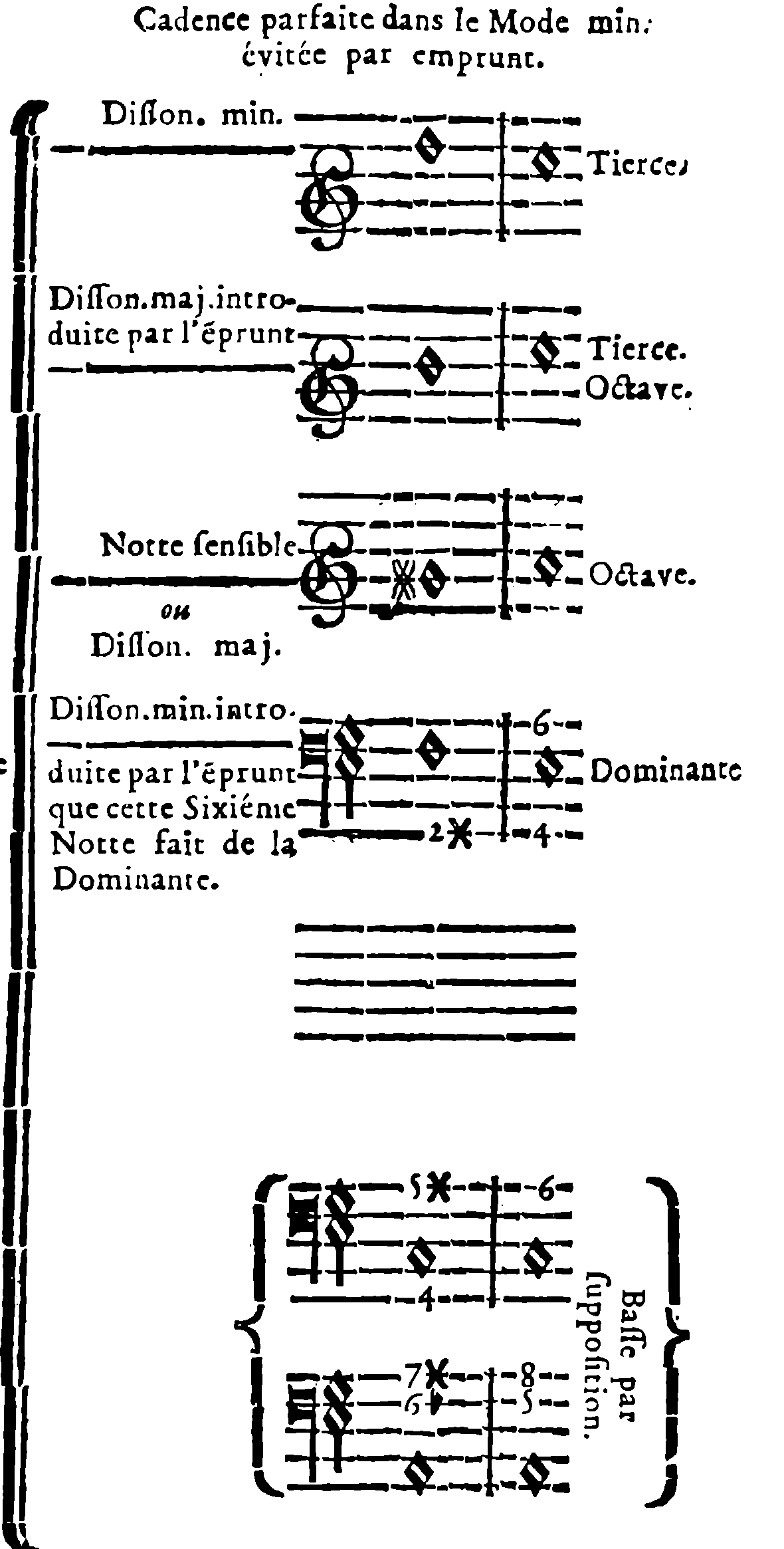 ▶ Fig. 56
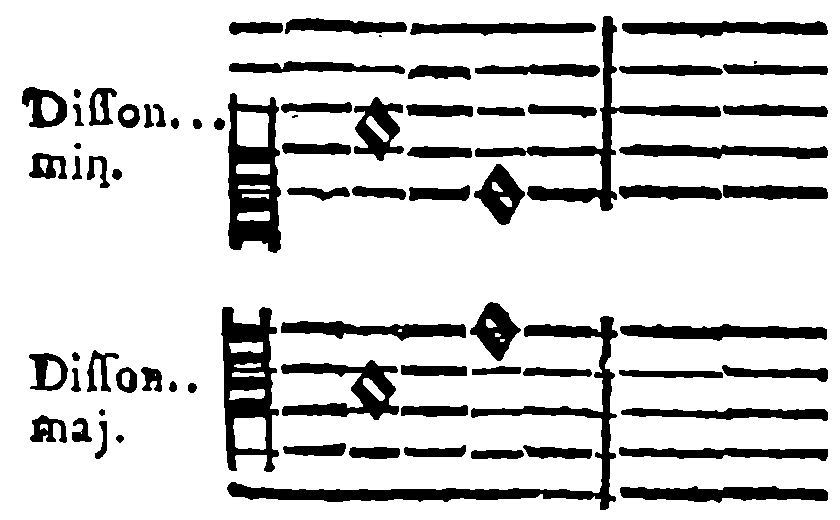 ▶ Fig. 98
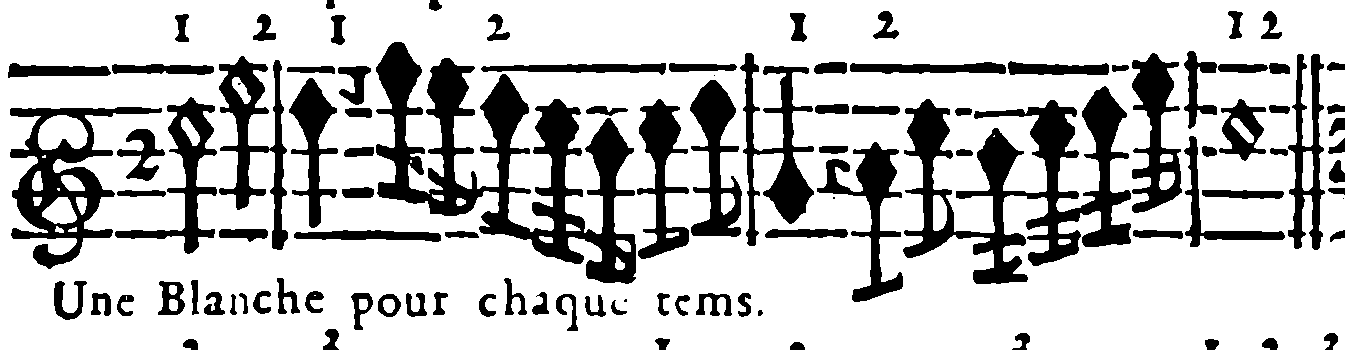 ▶ Fig. 184
 Practical Manual of HarmonyNikolai Rimsky-Korsakov, 1910
Start: The Minor Subdominant Chord and the Sixth Chord of the Second Degree in the Harmonic Major Mode →- Chords of the Strong and Weak Degrees, or Chords of the First and Second Order
b) The artificial harmonic major mode:
▶ Fig. 25 nearby - Triads
Leaving aside the augmented triad on the sixth degree of the harmonic major mode and the one on the third degree of the harmonic minor mode, there are nine different triads in the two major modes and nine in the two minor modes.
▶ Fig. 31 nearby - Seventh Chords
…contain an augmented fifth — those on the fourth and sixth degrees of the harmonic major mode and on the first and third degrees of the harmonic minor mode — there are nine different seventh chords in the two major modes and nine in the two minor modes.
▶ Fig. 41 nearby - Seventh Chords
…lacks. For progressions among chords on all degrees, the natural minor and harmonic major modes are used as well.
▶ Fig. 44 nearby - The Minor Subdominant Chord and the Sixth Chord of the Second Degree in the Harmonic Major Mode
§ 35. — 1) In the major-key exercises that follow, the group of subdominant chords of the harmonic major mode may be used:
▶ Fig. 121 nearby - The Minor Subdominant Chord and the Sixth Chord of the Second Degree in the Harmonic Major Mode
nor, in general, alternate too often within one phrase between the subdominant harmony of the natural major mode and that of the harmonic major mode.
▶ Fig. 122 nearby
6 more passages in Practical Manual of Harmony →
 ▶ C harmonic major scale, with A♭; “1½” marks the augmented second (a tone and a half) A♭–B
Chords of the Strong and Weak Degrees, or Chords of the First and Second Order ▶ D) Harmonic minor mode: triads on each degree of A harmonic minor; the augmented triad on III is bracketed
Triads ▶ D) Harmonic minor mode: seventh chords on each degree of A harmonic minor; those on I and III are bracketed
Seventh Chords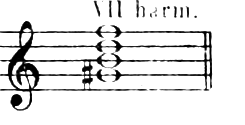 ▶ Leading-note seventh of A harmonic minor: G♯–B–D–F
Seventh Chords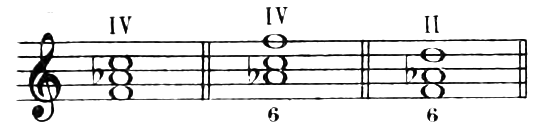 ▶ In C major: the minor triad of the fourth degree F–A♭–C, its first inversion (A♭–C–F, figure 6), and the sixth chord of the second degree with lowered fifth (F–A♭–D, figure 6)
The Minor Subdominant Chord and the Sixth Chord of the Second Degree in the Harmonic Major Mode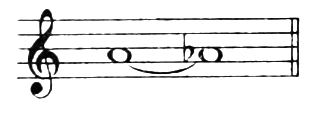 ▶ The chromatic motion A–A♭ (to be avoided)
The Minor Subdominant Chord and the Sixth Chord of the Second Degree in the Harmonic Major Mode
 Theory of HarmonyArnold Schoenberg, 1922
Start: Secondary Dominants and Modal Chords →- Parallel octaves and fifths
…have written parallel octaves for the sake of a worse sound. And the organ’s mixture adds to every voice not only simultaneously sounding octaves but also simultaneously sounding fifths*). This produces a stronger sound; but since we are dealing with artistic…
▶ Fig. 30 nearby - Parallel octaves and fifths · Footnote
*) I published this chapter in the August 1910 issue of the journal Die Musik. It was exposed to discussion, and I learned of several “objections” raised. They concern the organ mixture, and also—see the notes—organum in fifths and parallel thirds. I welcome…
▶ Fig. 30 nearby - Closes
In example 218 a plagal close was used in place of a cadence. This is often necessary in chorale harmonization, as in 226a, where one must resort to a plagal close if G is not to be the third of E-flat. The plagal close is a formula capable of ending even…
- Suspensions and Other Nonharmonic Tones
These intervening notes will generally circle or play around the resolving tone, staying melodically close to it; or they will be tones consonant with the chord of resolution; or a mixture of both (245c).
▶ Fig. 449 nearby
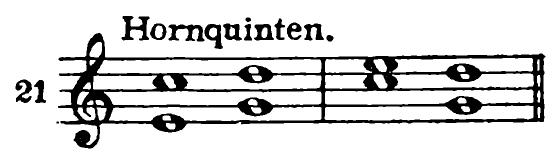 ▶ Example 21 — horn fifths
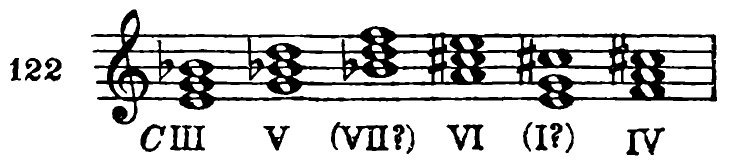 ▶ Example 122
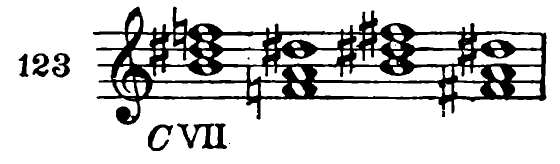 ▶ Example 123
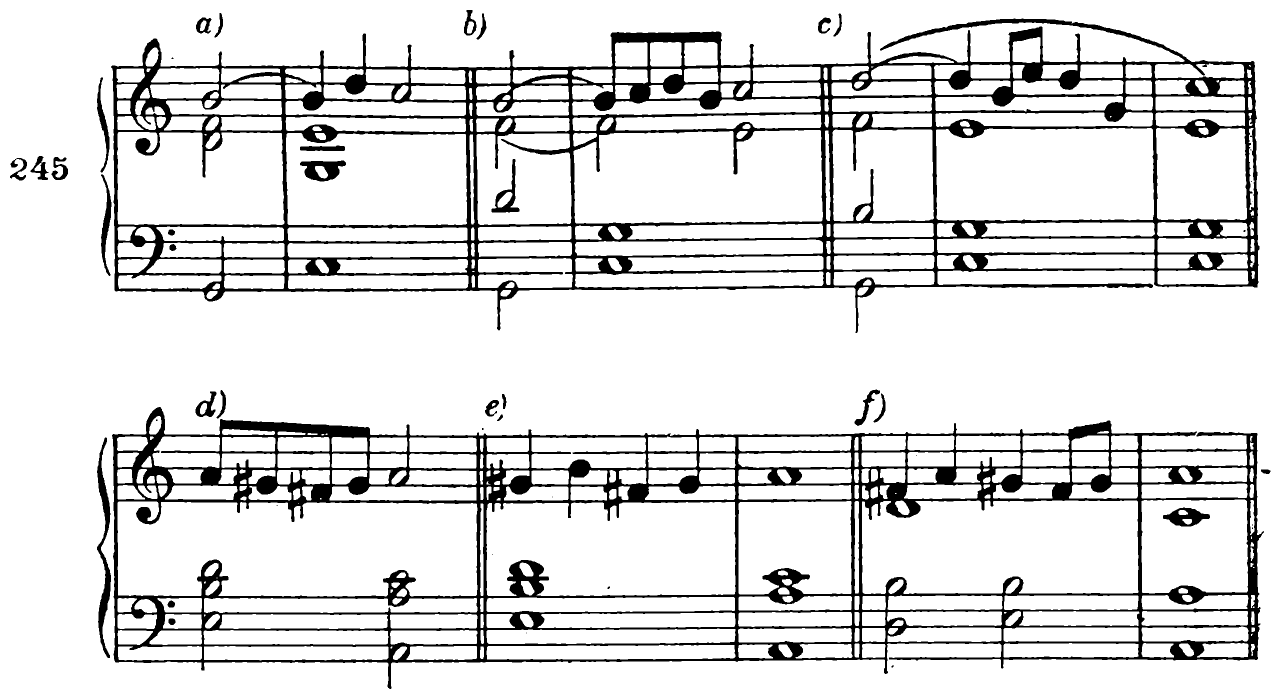 ▶ Example 245a
 Principles of OrchestrationNikolai Rimsky-Korsakov, 1922
- Harp
…his hands, but, in quick modulations, this method is not feasible, and the mixture of one chord with another produces a discordant effect. It follows that more or less rapid figures can only be realised clearly and neatly in the upper register of the harp,…
- Duplication in the brass
The imperfect balance arising from the duplication of the middle note is compensated for by the mixture of timbres, which lends some unity to the chord.
▶ Fig. 105 nearby
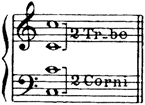 ▶ Fig. 105
 OrchestrationCecil Forsyth, 1914
- Classification of instruments
…end of the tube. This mouthpiece is either cupshaped, funnel shaped, or a mixture of the two. The player's lips stretch across the mouthpiece and themselves act as the vibrating reeds. The shape of the mouthpiece, especially the shape of its lower portion, is…
- Stringed instruments
…is preserved at Warwick Castle. The Citole was a hybrid-instrument, a mixture of Gittern and Lute. It combined the flat back of the former with the pear-shape of the latter. From the Gittern-type of instrument sprang the whole Lute-family, a large and…
- No. 49. The Cello
…as the ordinary bass of the string pizzicato, it possesses exactly the right mixture oi suppleness an what may be called left-hand pianoforte resongs. Used ayin, it giat a deligh call piquancy and a sort of subordinate prominence to its part. It is happiest…
- No. 56. The Dulcimer (or Cimbalom).1
…unnecessary. Even a mediæval Italian would scarcely have had the necessary mixture of cunning and hardihood to make the attempt.
- No. 56. The Dulcimer (or Cimbalom).1
Harmonics, mixture of Artificial and Natural, 334; use of, in orchestra, 334.
 Treatise on InstrumentationHector Berlioz, 1905
- The Violin
…where only a part of the strings (e.g. the first violins) employ mutes; the mixture of bright and muted tones produces a peculiar color. Sometimes the character of the melody is so different from that of the accompaniment that the use of mutes has to be…
- The Organ
…first the pp stops, then p. mp, mf, f and ff stops, up to perhaps a 6-rank mixture and finally a trumpet stop. Then we return similarly in a decrescendo from the fff to the ppp of the Aeolina. The crescendo pedal can certainly produce powerful effects if…
- The Melodium Organ
The melodium does not possess the mixture stops of the organ, whose effect excites a traditional admiration in many people, while in reality they cause terrible confusion. The melodium has only single and double octave stops, by means of which each key can…
- The Melodium Organ
…‘This crude metho¢ is, to be sure, not as bad as the mischief done with the mixture stops of the organ; for there the two other tone: of the common chord are heard at the same time (th major third and the fifth); but it remains crude jus the same.
More in Chords
Triads · Inversions and the chord of the sixth · The six-four chord · Seventh chords · The diminished seventh chord · Ninth chords · The Neapolitan sixth · Augmented sixth chords · Secondary dominants