 Playable Books
Concept index · Chords
The diminished seventh chord
Taught in 8 books. Each one opens at the passage; ▶ plays the example beside it. Also called diminished seventh, diminished seventh chord.
This index is Playable Books’ own: a first pass that finds the term’s words in each book, corrected by hand. The authors did not tag these passages, and their terms can differ (Fux’s “ligature” is a suspension). The quoted text is the book’s.
 Treatise on HarmonyJean-Philippe Rameau, 1722
Start: CHAPTER TWELVE. On Borrowed Chords, with Which Perfect Cadences Can Be Avoided while Being Imitated →- Table Explaining Essential Terms
The diminished seventh is the principle of all chords by borrowing, but must then lie beneath the chords, forming the lower sound of its inversion, the augmented second. 43 and 44
- Chapter five
…the tritone from the diminished fifth, and the augmented second from the diminished seventh. The dissonances that arise from augmented ones, such as the diminished second and diminished fourth, have no place in harmony, because augmented dissonances are…
- Chapter seven
…on one side we shall find on the other. For example, if we did not find the diminished-seventh chord in the first operations, we must seek it in these latter ones. We shall find it precisely in the numbers 125, 150, 180, 216, by adding a fourth proportional to…
- Chapter eight
3. If we take the seventh chord of Article III and transpose its lowest, fundamental sound a semitone higher, we form the chord in question. Observe that this transposition changes only a major third into a minor one. For example, from C, E, G, B♭, which…
- Chapter eight
Although the diminished-seventh chord seems to be generated first, because of the added fourth proportional, we must nevertheless relate our chords by supposition to the augmented-second chord, just as elsewhere we related them to the seventh chord. This…
- SUPPLEMENT: changes to two chapters and necessary corrections
Page 366, seventh paragraph: replace “for now, distinguish thirds from sixths, majors from minors …” with “for now, distinguish major thirds from minor thirds, and major sixths from minor sixths …”. Fifth line from the bottom in the small type: replace “the…
▶ Fig. 476 nearby
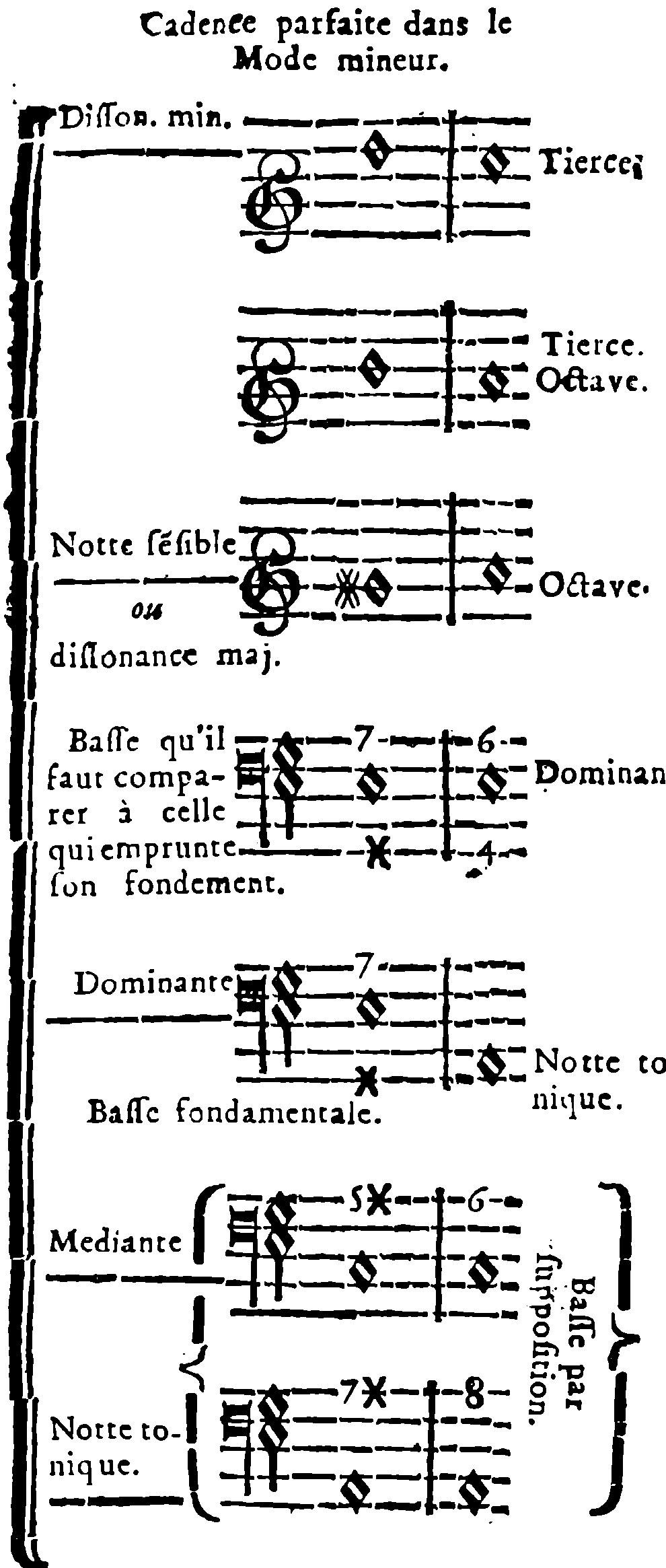 ▶ Fig. 55
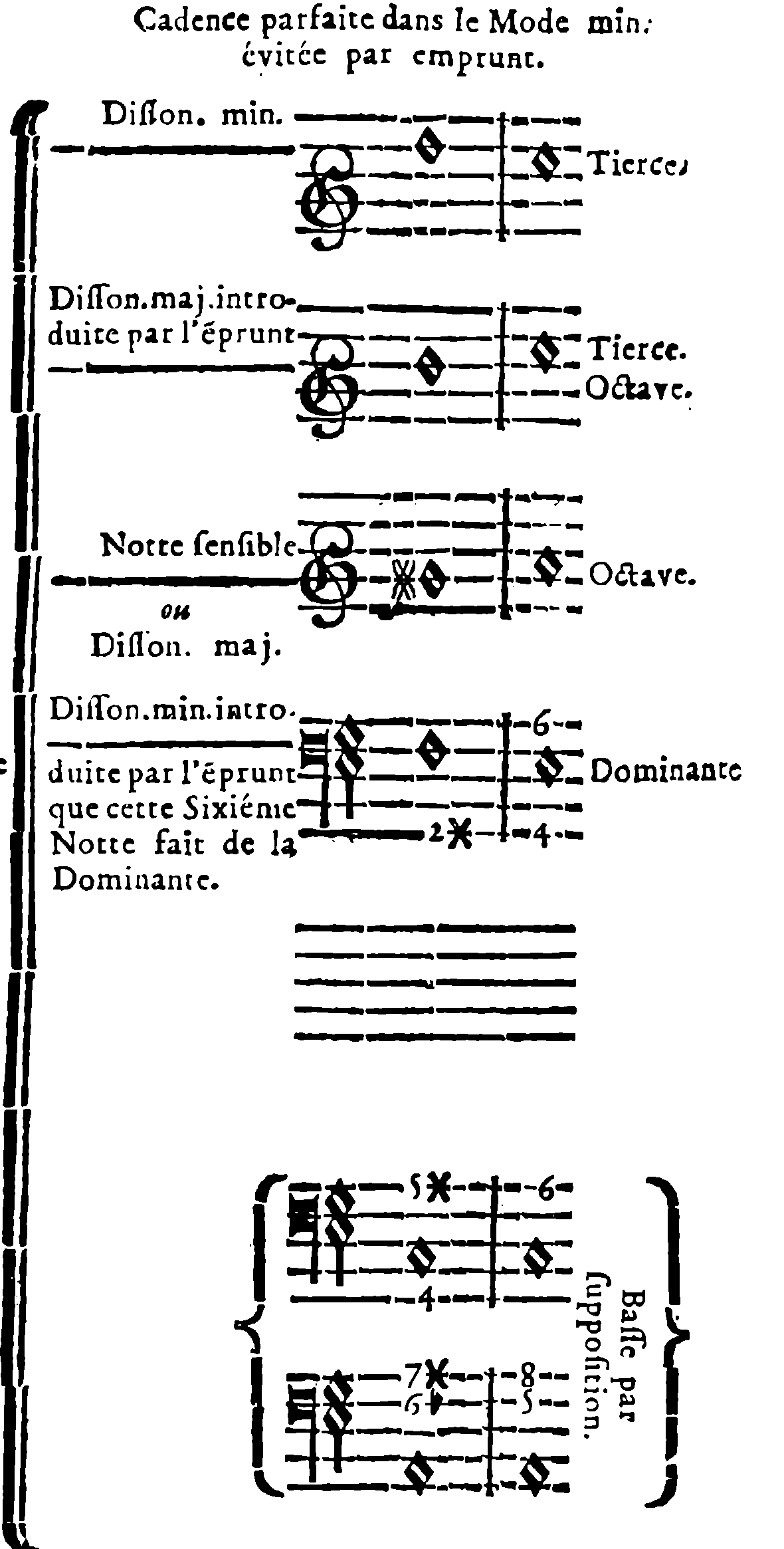 ▶ Fig. 56
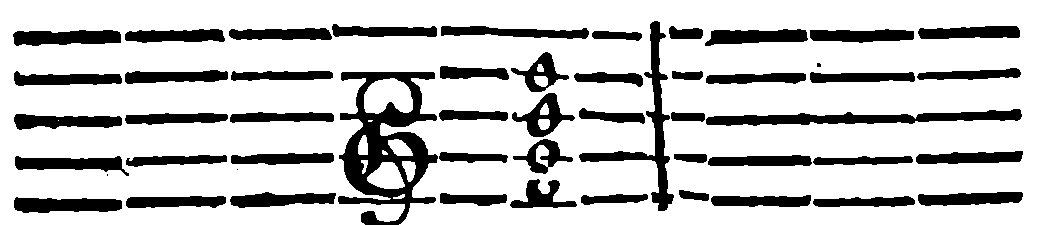 ▶ Fig. 476
 Practical Manual of HarmonyNikolai Rimsky-Korsakov, 1910
Start: Minor and Diminished →- The Artificial Dominant Seventh Chord and the Artificial Diminished Seventh Chord · 5 playable examples
- Enharmony of the Diminished Seventh Chord · 3 playable examples
- Suspension of the diminished octave or of the augmented unison
In certain cases, e.g. in chromatic modulation in minor, in the deceptive cadence in major, in the half cadence in minor, with a chromatic passing note, etc., the diminished seventh chord may produce a suspension forming a diminished octave with the bass:
▶ Fig. 303 nearby - Altered Chords
The artificial dominant seventh chord on the 2nd degree of the major key, the diminished seventh chord on the 2nd degree of the major key, and the major triad on the 2nd degree of the major and of the minor key.
- The Artificial Dominant Seventh Chord and the Artificial Diminished Seventh Chord
2) The artificial diminished seventh chord arises from combining the preceding alteration with an alteration of the root of the same chord; it resolves to the 1st degree only.
▶ Fig. 337 nearby - The Artificial Dominant Seventh Chord and the Artificial Diminished Seventh Chord
REMARK.— When the artificial diminished seventh chord is prepared by the triad of the IVth degree, one of the parts moves down by a diminished third:
▶ Fig. 340 nearby - The Artificial Dominant Seventh Chord and the Artificial Diminished Seventh Chord
6) The artificial diminished seventh chord cannot be formed on the IInd degree of the minor mode.
▶ Fig. 341 nearby - Enharmonic Modulation
§ 83. — As means of sudden modulation one uses the enharmony of augmented-sixth chords, of diminished-seventh chords and of augmented-fifth chords, as well as the numerous cases of polytonic successions.
5 more passages in Practical Manual of Harmony →
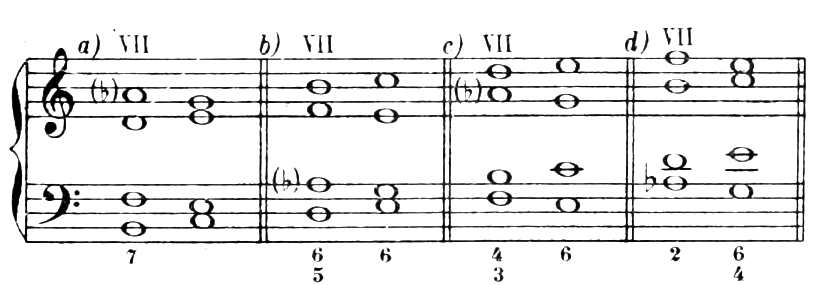 ▶ Leading-note seventh chord (A♭ or A) in root position and its three inversions, each resolving to the tonic triad with doubled third
Minor and Diminished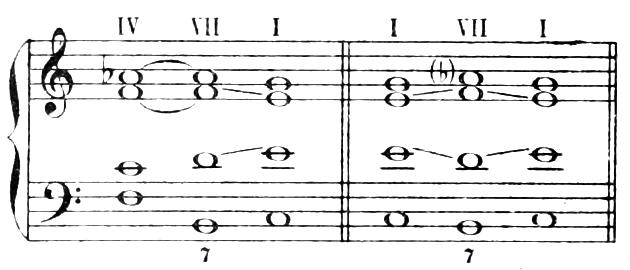 ▶ Leading-note seventh chord in C major: IV–VII7–I (prepared by IV, two common notes) and I–VII7–I (prepared by I)
Minor and Diminished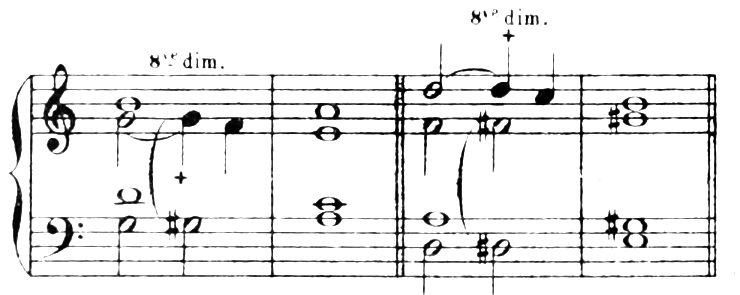 ▶ Two progressions separated by a double bar. First: G major chord, then the bass moves chromatically to G sharp while the alto G is held as a suspension, a diminished octave above the bass, before falling to F (diminished seventh chord), resolving to A minor. Second: D minor chord, then the bass moves to D sharp while the soprano D is held as a suspension, a diminished octave above the bass, before falling to C (diminished seventh chord), resolving to E major.
Suspension of the diminished octave or of the augmented unison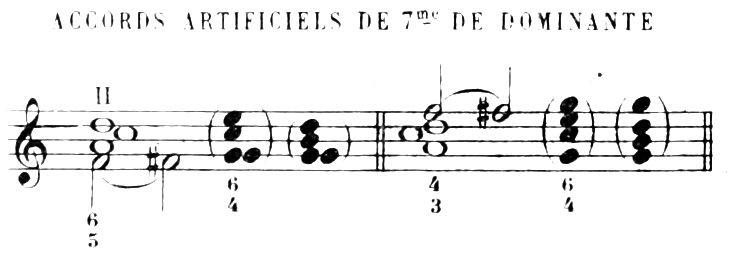 ▶ ARTIFICIAL DOMINANT SEVENTH CHORDS. Example in C major: the seventh chord of the 2nd degree (II) as a 6/5 chord, F–A–C–D, whose bass F rises to F♯ (D–F♯–A–C), resolving to the tonic 6/4 chord G–C–E or (in parentheses) to the G major chord; after a double bar, the same chord as a 4/3 chord, A–C–D–F, with the upper F rising to F♯, resolving to the tonic 6/4 chord or (in parentheses) to the G major chord.
The Artificial Dominant Seventh Chord and the Artificial Diminished Seventh Chord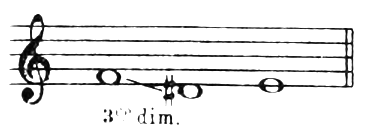 ▶ Diminished third (3ce dim.): F falls to D#, which rises to E.
The Artificial Dominant Seventh Chord and the Artificial Diminished Seventh Chord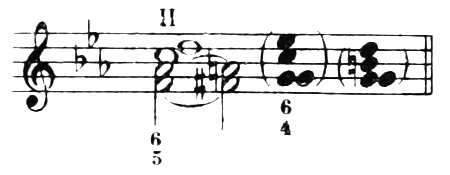 ▶ Example in C minor: over the whole-note D, the II chord F–Ab–C (6/5) becomes F#–A natural–C (third and fifth both raised), followed in parentheses by the six-four chord G–C–Eb (6/4) and the chord G–B natural–D.
The Artificial Dominant Seventh Chord and the Artificial Diminished Seventh Chord
 Guide to the Practical Study of HarmonyPyotr Ilyich Tchaikovsky, 1900
Start: Chapter XIII. Chords of the minor and diminished Seventh →- Chapter XXI. The enharmonic properties of the chord of the diminished seventh · 5 playable examples
- Table of contents
Chapter XIII. Chords of the minor and diminished Seventh — 41
- Table of contents
Chapter XXI. The enharmonic properties of the chord of the diminished seventh — 75
- Chapter XIII. Chords of the minor and diminished Seventh
§ 39. The chord of the diminished seventh gains greatly by being prepared, though this is not absolutely necessary, as in the case of the minor seventh-chord.
▶ Fig. 105 nearby - Chapter XVI. Chords of sequence in minor
1V. The chord of the seventh on the 4-th degree is commonly resolved into the chord of the diminished seventh, and not into the triad, in order, firstly, that the third should not make the steps of the augmented second, and that, secondly, when the third…
▶ Fig. 145 nearby - Chapter XXI. The enharmonic properties of the chord of the diminished seventh
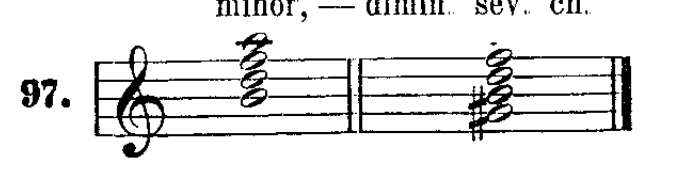
§ 61. The diminished seventh chord consists of three minor thirds erected one on the other. In the inversions of the chord, we obtain in place of minor thirds, their enharmonic equivalents—angmented seconds. If we now substitute these augmented seconds by the…
▶ Fig. 209 nearby - Chapter XXI. The enharmonic properties of the chord of the diminished seventh
So that every diminished seventh chord is the equivalent of three other diminished seventh chords. Twelve keys, in all, are known to us; consequently we recognize but three diminished seventh chords distinct in sound.
▶ Fig. 210 nearby
13 more passages in Guide to the Practical Study of Harmony →
 ▶ Fig. 101
Chapter XIII. Chords of the minor and diminished Seventh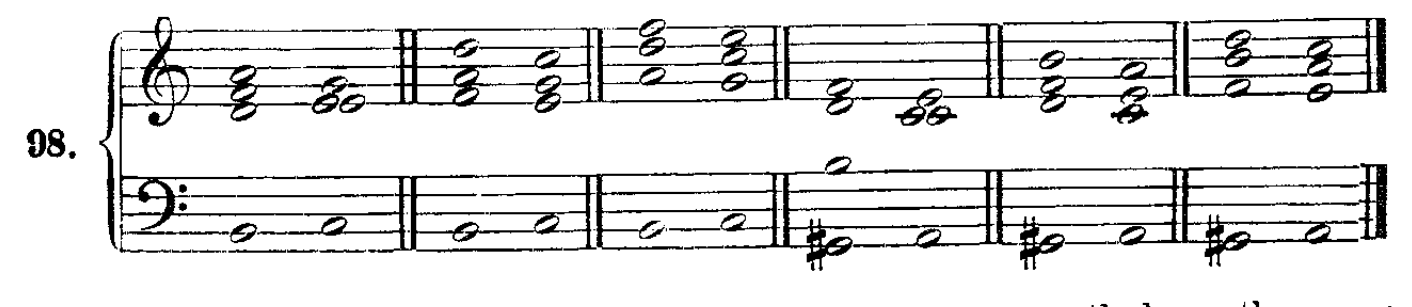 ▶ Fig. 102
Chapter XIII. Chords of the minor and diminished Seventh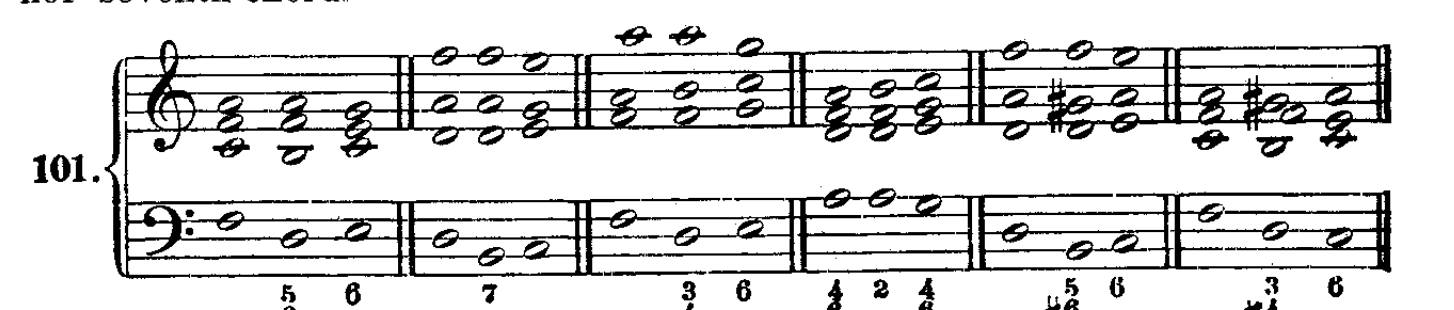 ▶ Fig. 105
Chapter XIII. Chords of the minor and diminished Seventh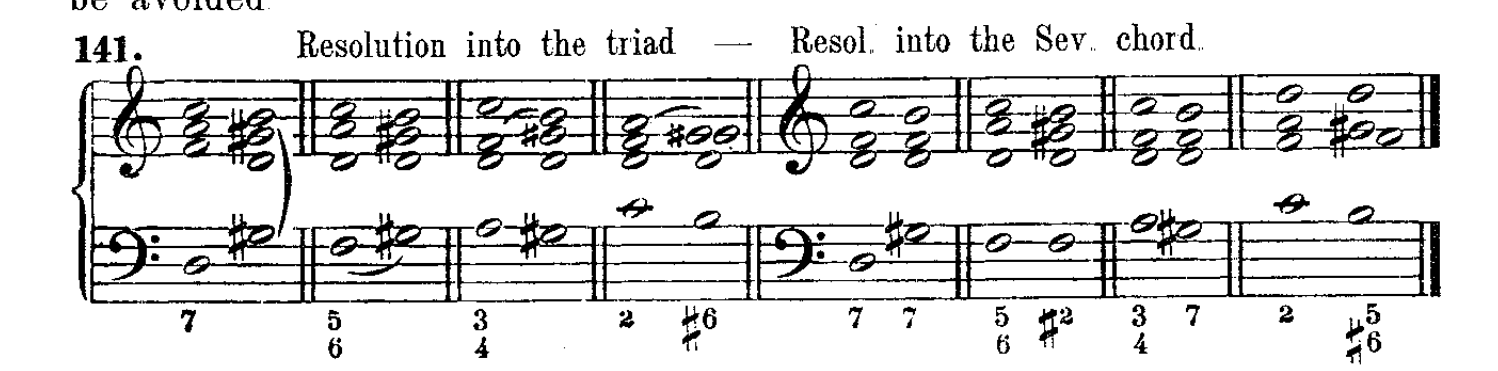 ▶ Fig. 145
Chapter XVI. Chords of sequence in minor ▶ Fig. 209
Chapter XXI. The enharmonic properties of the chord of the diminished seventh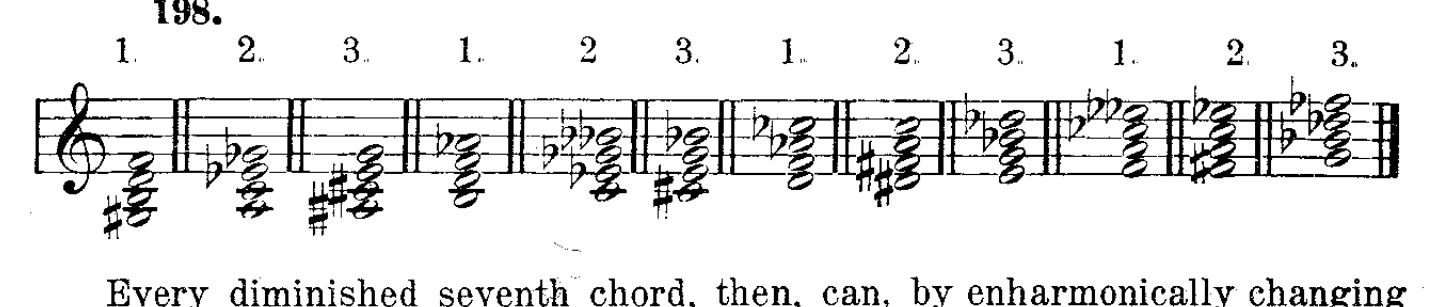 ▶ Fig. 210
Chapter XXI. The enharmonic properties of the chord of the diminished seventh
 Theory of HarmonyArnold Schoenberg, 1922
Start: On the Diminished Seventh Chord →- On the Diminished Seventh Chord
…in keeping with the earlier procedure, by trying to transplant the diminished seventh chord, too, to places where it does not occur naturally. For this, the first thing to consider is to place it on those degrees that recall a VII of minor in that their root…
▶ Fig. 217 nearby - On the Diminished Seventh Chord
…first three chromatically successive lowest notes already produce all the diminished-seventh sonorities there are. For example: F, A-flat, C-flat, D; then F-sharp, A, C, E-flat; and G, B-flat, C-sharp, E. The next division, from G-sharp (A-flat), yields the…
▶ Fig. 220 nearby - On the Diminished Seventh Chord
One thing we shall hold to most strictly: we do not use the diminished seventh chord as is generally customary, like a universal remedy from the household medicine chest—aspirin, for example—that cures all ills. Rather, as a ninth chord with omitted root, it…
▶ Fig. 221 nearby - On the Diminished Seventh Chord
…to I; in c) III going to VI; in d) VII going to III. But in a), at †, the diminished seventh chord B–D–F–A-flat standing on the II degree of F connects with the I of F. This diminished seventh chord is here, of course, designated as the II degree (imagined…
▶ Fig. 233 nearby - Down Three or Four Fifths
In 154 c the diminished seventh chord is followed by the directional seventh chord on the I degree of C. The tones of the diminished seventh chord need not necessarily arise through chromaticism (154 d). Likewise, we may here already allow ourselves (at first…
▶ Fig. 264 nearby - 4. More Chord Possibilities
…especially in Richard Strauss, is the use of different bass tones with a diminished seventh chord. This rests on the fact that a diminished seventh chord can be understood in four ways as a ninth chord. If one imagines a sufficient pause, or an event…
▶ Fig. 562 nearby
 ▶ Example 138
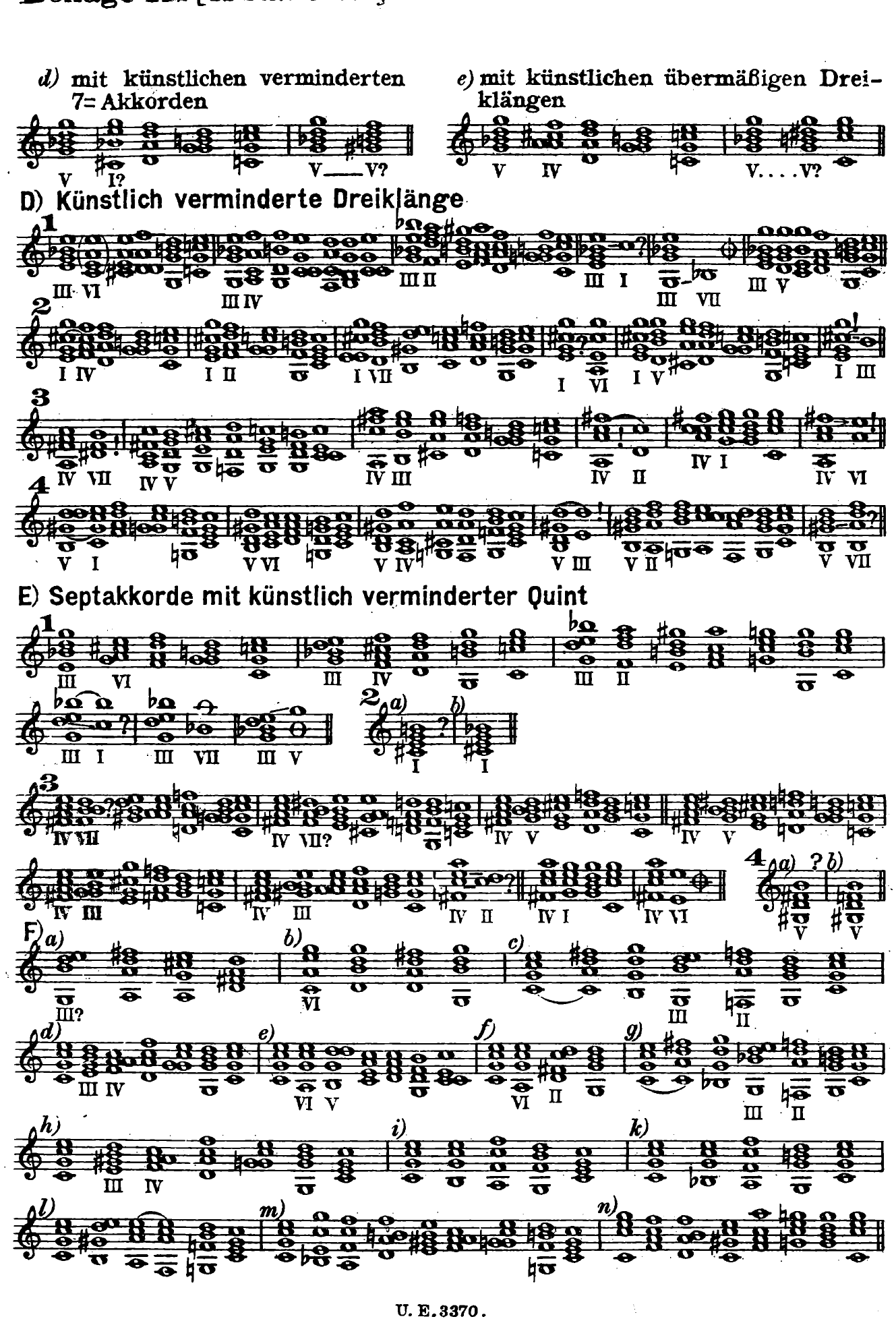 ▶ Example 137-a2-Cd
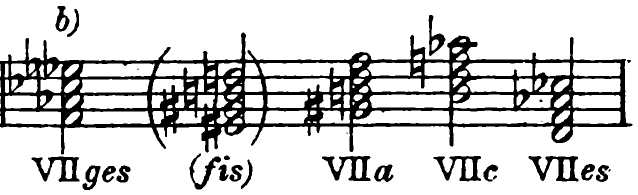 ▶ Example 139b
 ▶ Example 140A, 1
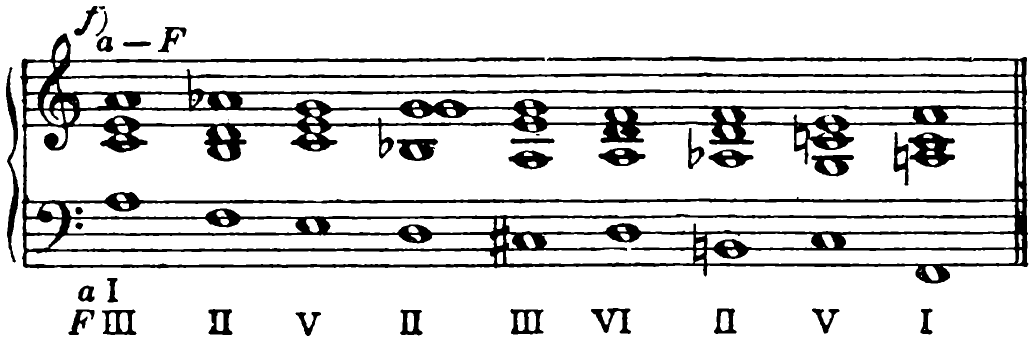 ▶ Example 140B f), a–F
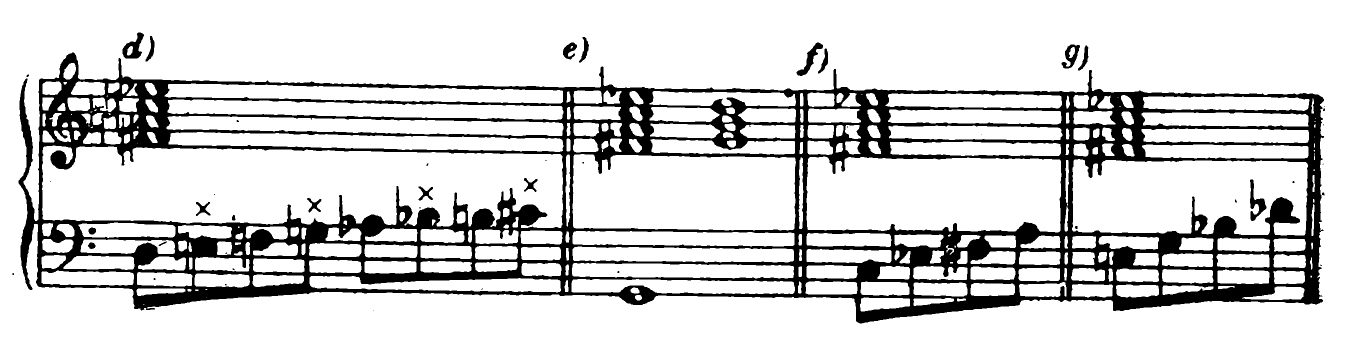 ▶ Example 304d
 Principles of OrchestrationNikolai Rimsky-Korsakov, 1922
- Number of harmonic parts—Duplication
This applies also to other chords of the seventh and diminished seventh:
▶ Fig. 39 nearby - Diverging and converging progressions
…the Sea-King appears (Ex. 261). Both examples include a sustained stationary chord of the diminished seventh. The handling of such progressions requires the greatest care.
- Harmonic basis
Chords the most widely opposed in character may be used on a simple, stationary harmonic basis, a basis, founded, for example, on the chord of the tonic or diminished seventh.
- Harmonic basis
No. 271. The Golden Cockerel 125—Chords of the diminished seventh, on arpeggio basis (augmented fifth).
- Instruments on the stage and in the wings
i) Lyres. Instruments specially made and tuned so as to be able to perform a glissando chord of the diminished seventh:
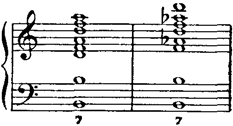 ▶ Fig. 39
 OrchestrationCecil Forsyth, 1914
- Stringed instruments
Chords of the "Diminished Seventh"
- Stringed instruments
In the following chords and parts-of-chords of the diminished seventh the easiest notation is adopted. Any enharmonic variations of these chords can, of course, be used.
- No. 49. The Cello
Parts of "Diminished Sevenths."
- No. 49. The Cello
In four-parts all "diminished sevenths" are out of the question.
- No. 51. The Double-Bass.'
…should notice here how carefully the chords are restricted. There are no "diminished-sevenths" and "Six-four-two's" as in the Berlioz example. This is in the interests of lightness and clarity. Furthermore, he should notice in performance how intensely soft…
- No. 52. The Harp
…used oi these chords are the parts of minor ninth chords usually known as "diminished sevenths, " but dominant sevenths and the upper portions of major ninths and elevenths are also available. In the following list the notes which are taken as…
 Treatise on InstrumentationHector Berlioz, 1905
- The Violin
Sequences of diminished seventh chords are also easy because the fingering remains the same while
- The Double-Bass
…all the more terrible as the composer uses the third inversion of the diminished seventh chord (F-G#-B-D). Furthermore, to give his idea all the weight and vehemence possible, he doubles the basses not only with the violoncellos but also the violas and the…
- The Double-Bass
…derives its threatening and infernal effect only from the echo of the diminished seventh chord
- The Harp
A brilliant example for the above mentioned method of glissando (on the diminished seventh chords) is to be found in Liszt’s Dante-Symphony; here it symbolizes the spirits of the unfortunate Francesca da Rimini and her lover as they rise from the inferno.…
- Clarinets
…If, for example, three clarinets are available for the chord C%-E-Bd, this diminished seventh, if well motivated, well introduced and scored in this fashion, would have an awesome aspect, whose gloom might be increased even further by the addition of the low G…
 ArrivalMayank Sanganeria, 2026
- Chapter 5 — Outlines
3-to-♭9 (G7 to Cmaj7). B D F A♭ is 3, 5, 7, ♭9 of G7. Those four notes form a diminished seventh chord, so the line implies G7♭9 without the rhythm section changing anything. A♭ falls a half step to G, the 5th of C. Landing on the 5th is the exception to the…
▶ Fig. 13 nearby
 ▶ Ex. 5.1
More in Chords
Triads · Inversions and the chord of the sixth · The six-four chord · Seventh chords · Ninth chords · The Neapolitan sixth · Augmented sixth chords · Secondary dominants · Borrowed chords (mixture)
All concepts · Search every passage for “diminished seventh”